What is Industrial Screen Printing? Machine, Production Line and Equipment Selection Guide
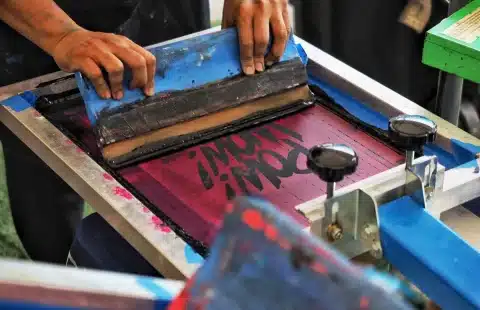
Industrial screen printing; Stencil printing is a method that enables controlled, repeatable, and production-oriented printing on textiles, plastics, PVC, glass, metal, paper, cardboard, wood, labels, panels, packaging parts, and various promotional products. Ink or dye is transferred from open areas on a stretched silk or synthetic mesh to the printing surface using a squeegee.
An application doesn't necessarily have to be performed on a fully automated machine to be considered industrial. Manual, semi-automatic, or pneumatic systems can also be part of industrial production with the right machinery, molds, paints, drying equipment, and quality control setup. The key difference is that the printing is done with defined production parameters and a repeatable result target, not through random trials.
When setting up an industrial production line, you need not only a printing press, screen printing machines, printing plates, professional screen printing materials, It is necessary to evaluate paint selection, exposure system, drying, plate cleaning, and operator flow together. Users who are new to learning the basic steps of the process should first... A professional guide explaining how screen printing is done. can examine.
Short answer: Industrial screen printing is a production method where parameters such as the printing surface, ink, mold, mesh, squeegee, machine, drying, and quality control are standardized. Manual machines are suitable for low to medium-volume production, while semi-automatic systems are used for jobs requiring higher speed and repeatability.
Contents
- What is industrial screen printing?
- How does industrial screen printing work?
- In which sectors is it used?
- Manual, vacuum and semi-automatic machines
- How to choose the right screen printing machine?
- Surface and paint compatibility.
- Mold, mesh and emulsion selection
- How to set up an industrial production line?
- Quality control and repeatability
- Common printing errors and their solutions
- Occupational safety and chemical management
- Cost and capacity planning
- City-based machinery and material supply.
- Frequently Asked Questions
What is Industrial Screen Printing?
Screen printing is based on the principle of transferring ink from open pores on a stretched mesh to the printing surface. Closed areas prevent ink passage, while open areas corresponding to the design create the printed image. (The Metropolitan Museum of Art's...) in the screenshot technique explanation The basic principle of the method is defined as the transfer of ink from a templated mesh to the surface.
In industrial applications, this basic principle is supplemented by production standardization. The goal is to achieve similar results in terms of color, position, ink thickness, edge sharpness, and adhesion to the surface when the same job is reprinted. To achieve this, the following variables must be recorded for each job:
- The type of material to be printed on and the surface condition.
- Printing area and product external dimensions
- Mold outer dimensions and mesh structure
- Emulsion type and coating arrangement
- Exposure camera and test result.
- The paint or ink system used
- Ragle structure, angle, pressure and pressing speed
- Working adjustment between the table and the mold.
- Drying or fixing method
- Surface preparation and cleaning processes
Published by ISO ISO 12647-5 screen printing standard, This standard addresses specific stages of four-color process screen printing production, particularly in display, signage, and graphic design. It is not a single production recipe directly applicable to all screen printing applications; however, it is important because it demonstrates the need to consider data preparation, proofing, plate making, and production control together.
Short answer: The fundamental difference between screen printing and industrial screen printing is not the printing principle, but the way production is managed. In industrial production, materials used, machine settings, mold recipes, drying conditions, and quality criteria are recorded to ensure the work can be reproduced reproducibly.
Does industrial screen printing only mean high volume?
No. Quantity is an important selection criterion, but it is not the sole determining factor. A business might print a limited number of machine panels, metal labels, or technical parts per day. Even with low print volumes, if positional accuracy, ink durability, and product consistency are critical, the application has industrial characteristics.
However, printing a large number of products does not mean that production is automatically controlled. Significant waste can occur even in high-volume production due to incorrect ink, uneven plate tension, insufficient drying, or variable operator pressure.
Briefly
- Repeatability is at the heart of industrial production.
- Full automation is not required.
- Low-volume technical part printing can also be industrial.
- Machinery, molding, painting, and drying should all be considered within the same system.
How does industrial screen printing work?
Industrial screen printing production begins long before the printing itself. Design preparation, color separation, film output, plate selection, emulsion coating, exposure, washing, drying, machine setup, and sample checking are all integral parts of the production process.
1. Preparing the printing data
The design should be prepared according to the actual size to be printed. In multi-color applications, a separate film and plate may be required for each color. Fine lines, small text, halftone texture, and negative areas affect film density and plate selection.
In industrial applications, it's not enough for a file to simply look visually correct. Printing tolerances, product placement in the mold, marking points, and color overlapping patterns must also be determined before production.
2. Mold preparation
The mold surface is cleaned, degreased, and coated with a suitable emulsion. An uneven emulsion layer can cause different paint deposits or exposure problems in various areas of the mold.
Businesses looking to compare the basic equipment required for mold making. screen printing exposure machines can be examined. In small and medium sizes. 50x70 screen printing exposure machine, in broader contexts 70x100 screen printing exposure machine This can be considered. When selecting a model, not only the print image but also the outer dimensions of the mold should be taken into account.
To thoroughly evaluate the exposure equipment decision. Screen printing exposure machine selection guide, also to see why the time setting shouldn't be done by rote. Screen printing exposure time calculation guide available.
3. Attaching to the machine and securing the product.
After connecting to the plate printing machine, the position of the product on the build plate is determined. On flat, thin, slippery, or lightweight materials, product movement during printing can cause position shift, double images, and edge distortion. In such applications, a vacuum build plate offers a significant advantage.
In flat surface production screen printing vacuum manual printing machine It helps to hold the product stable on the print bed. Suitable for longer print areas. 70x200 vacuum manual printing machine or 100x200 vacuum manual printing machine Larger solutions, such as these, may come to the fore.
4. Transferring the paint to the surface
The squeegee moves the paint across the mold, transferring it to the product through open mesh areas. The printing result is affected by the condition and angle of the squeegee blade, operator pressure, movement speed, paint flow characteristics, and mold operating settings.
In the same process, one operator applying too much pressure and another applying too little can alter the paint thickness. In industrial production, the goal is to make the printing motion as defined and repeatable as possible.
5. Drying or fixing
The drying method for the printed product should be determined according to the dyeing system used. In some applications, simply allowing the products to sit without contact may be sufficient, while some textile dyeing systems may require controlled fixation. Technical specifications must be verified with the dye manufacturer's current documentation.
To store flat products neatly screen printing drying systems Available in standard production. screen printing paint drying rack, in smaller products 50x70 custom size drying rack, For larger parts, however... 100x185 custom size rail assessable.
In textile or heat-fixing dyeing systems conveyor dryer fixing tunnel, This can help ensure more consistent production progress. However, a fixed value should not be used for temperature, belt speed, and dwell time; the paint technical data sheet and actual sample tests should be taken as a basis.
Short answer: Industrial screen printing production consists of the following stages: data preparation, mold creation, machine setup, product fixing, ink transfer, drying, and quality control. Even the most advanced printing machine cannot provide consistent results on its own if any of these stages are left unchecked.
Briefly
- Production doesn't begin with the printing press, but with the right file and plate preparation.
- The vacuum plate provides stability on flat products that may slide.
- The drying method should be selected according to the paint system.
- Sample prints and a recorded production recipe must be created for each job.
In which sectors is industrial screen printing used?
One of the most important advantages of screen printing is that it can be used on a wide variety of product geometries and material types. However, the phrase "screen printable" does not mean that the same ink and machine can be used on every material. To see a broad overview of applicable surfaces, please refer to the image below. Guide to products that can be screen printed.It can be examined.
| Sector | Sample products | The most important need |
|---|---|---|
| Textile | T-shirt, tote bag, sweatshirt, piece of fabric | Plate layout, paint-fixture compatibility, color exposure. |
| Advertising and signage | PVC sheet, plexiglass, panel, directional sign | Large printing area, paint adhesion, drying |
| PACKAGING | Cardboard box, plastic packaging piece, lid | Position repeatability, surface conformity, rapid product flow. |
| Pine | Decorative glass, bottles, jars, panels | Surface cleaning, suitable paint, controlled drying. |
| Metal | Machine label, aluminum panel, device surface | Strength, surface preparation, scratch resistance. |
| Plastic and PVC | Label, sign, promotional item, technical part | Determining the type of plastic, paint adhesion test. |
| Promotion | Files, bags, boxes, agendas, plastic products | Product fixing device and quick mold change |
| Electronic and technical production | Panel signs, graphic overlays, custom circuit applications. | Precision molding, process control, dimensional accuracy. |
Textiles and multi-color printing
In textile production, it is essential that the product is placed smoothly on the printing plate, that the platen is in the same position for each print, and that each color is printed in the correct position. This is for single-arm production. t-shirt printing press, In applications requiring multiple color stations, Desktop 4-color 1-station screen printing press assessable.
Before starting a textile business, it's necessary to evaluate the product, dyeing, fixing, and workshop workflow as a whole. This is especially important for businesses just starting out in the field. A beginner's guide to screen printing., It helps in prioritizing fundamental investment decisions.
Printing on glass and cylindrical products
Cleanliness, surface energy, paint compatibility, and curing conditions are important for glass surfaces. Flat glass and bottles or jars are not evaluated in the same machine structure. To see the basic stages of flat glass printing... screen printing glass printing guide available.
For cylindrical products such as bottles, jars, and tubes, the product needs to rotate during printing. For this type of production... semi-automatic circular printing machine, It offers a different motion system than flat table machines.
Metal, panel and large surface prints.
As the print size increases on machine panels, metal labels, signs, long sheets, or wide signage, the build plate, mold, and drying area must also increase. This is especially important for certain large parts that do not require vacuuming. 80x250 vacuum-free manual printing machine Long table solutions such as these can be considered.
Short answer: Industrial screen printing can be used on textiles, glass, metal, plastic, PVC, paper, cardboard, panels, packaging, labels, and promotional products. For proper application, not only the material name but also the coating, flexibility, geometry, and usage conditions of the product must be determined.
Briefly
- The same paint is not used for every surface.
- Flat and cylindrical products require different machine movements.
- The large printing area necessitates a larger plate and drying area.
- In textile production, the fixing process is as important as machine selection.
Manual, Vacuum and Semi-Automatic Screen Printing Machines
Choosing an industrial screen printing machine shouldn't be reduced to a simple "manual or automatic?" question. The product to be printed, daily production targets, number of operators, varying job frequency, and expected precision should all be considered together.
| Machine type | Proper use | Advantage | Things to pay attention to |
|---|---|---|---|
| Desktop mount | Sample, small series, training and introductory | Compact installation and low space requirement. | High volumes can increase operator workload. |
| Manual foot-operated device | Different table layouts and small workshops | Working height and flexibility of use. | Product fixing should also be planned. |
| Vacuum manual machine | Paper, PVC, labels, sheets and flat pieces | It reduces the movement of the product on the platform. | The plate size and vacuum area must be suitable for the product. |
| Semi-automatic flat printing | Repetitive, high-volume jobs | More standardization in the Ragle motion. | Air infrastructure, equipment and operator flow must be planned. |
| Semi-automatic circular printing | Bottles, tubes and jars | It controls the movement of cylindrical products. | The diameter, printing area, and product apparatus should be checked. |
Initial and sample production
For samples, training, and small batch jobs. screen printing desktop printing apparatus or screen printing stand That might be sufficient. These systems offer a controlled start for businesses that don't want to invest in a large production line without seeing the product range and actual order volume.
Professional flat surface production.
For products such as paper, cardboard, labels, PVC, or thin sheets, the vacuum table reduces part movement during printing. Although it is a manual system, regular commercial production can be achieved with the right apparatus, molds, and workflow.
Semi-automatic production
In productions where it becomes difficult for the operator to repeat the squeegee movement in the same way with each print Desktop semi-automatic screen printing machine It is worth considering. The semi-automatic structure can help to perform paint spreading and printing movements in a more controlled manner.
However, the fact that the machine is semi-automatic does not automatically solve the bottlenecks in product feeding, product receiving, drying, and quality control. If the workflow around the machine is inadequate, overall production may not increase even if the printing speed is increased.
Short answer: For low-volume and variable jobs, manual systems should be considered; for flat and sliding products, vacuum machines; for continuously repeating production, semi-automatic machines; and for cylindrical products, circular pressing systems. The most suitable model is determined according to the product and production flow.
How to Choose an Industrial Screen Printing Machine?
The first thing to consider when choosing a machine is not price or appearance. First, you need to determine what the business will be printing, how the product will be fed, and where it will be transferred after printing. For detailed purchasing criteria, see [link to purchasing criteria]. Guide to choosing a screen printing machine. It can be examined.
1. Determine the external dimensions of the product.
Even if the print image is small, the entire product must fit on the build plate. For example, if a logo is to be printed on only a small section of a large panel, the machine selection is made not according to the logo size, but according to the outer dimensions of the panel and the movement area on the build plate.
2. Calculate the outer dimensions of the mold.
The plate is larger than the print image. Selections made without considering the plate frame, travel allowance, and machine connection system may result in the print area being unusable.
3. Assess the need for vacuuming.
Products such as paper, thin PVC, film, labels, or lightweight sheets may stick to the printing plate or slide on the build plate during printing. In such cases, a vacuum system is an important selection criterion. For heavy, stationary products or those held with special apparatus, a vacuum system may not be necessary.
4. Calculate the daily production target.
Instead of just the theoretical cycle of the machine, the entire workflow must be calculated. The times for product placement, printing, product retrieval, visual inspection, and transfer to the drying area should be measured together.
5. Evaluate the frequency of product exchanges.
The needs of a workshop that prints a different product every day differ from those of a production line that prints the same product for months. Frequent product changes require quick setup and tool changes; while consistent production requires standard cycles and repeatability accuracy.
6. Check the technical support and spare parts process.
When purchasing industrial machinery, it is important that the manufacturer or supplier is accessible not only during the sales process but also during installation, adjustment, maintenance, and spare parts processes. For supplier evaluation... A guide to choosing a screen printing machine manufacturer in Türkiye. available.
Short answer: When choosing an industrial screen printing machine, factors such as product dimensions, die dimensions, table structure, vacuum requirements, production quantity, product changeover frequency, drying method, workshop space, and technical support should all be considered. Simply choosing the largest or fastest machine is not the right approach.
Printing Surface and Ink Compatibility
In industrial printing, the starting point for ink selection is not color, but surface. The term "plastic" alone is insufficient; different types of plastics and surface treatments can exhibit different adhesion behaviors. The same applies to metal, glass, textiles, and coated cardboard.
| Surface | Something to check | Sample test |
|---|---|---|
| Textile | Fabric composition, color, elasticity, and fixation requirements. | Washing, stretching, and friction control. |
| PVC and plastic | Plastic type, additives, surface energy, and cleanliness. | Adhesion, scratching, and post-waiting inspection. |
| Pine | Oil, dust, coatings and usage environment. | Adhesion and durability test according to usage conditions. |
| Metal | Metal type, paint or coating, oil and oxide. | Scratch, solvent, and usage condition testing. |
| Paper and cardboard | Absorption, coating and deformation risk | Institution, backflow and surface degradation control. |
Regardless of the product name or catalog description, samples must be made on actual parts before industrial production begins. Surface preparation, thinning, waiting, curing, and safety instructions specified in the paint's technical data sheet must be followed.
To evaluate screen printing inks, emulsions, squeegees, and cleaning products together. Screen printing auxiliary materials category It can be reviewed. To see all the essential products the workshop will need in a single list, click here. Guide to materials needed for screen printing. available.
Why is surface preparation important?
Surface oil, silicone, mold release agents, dust, moisture, or protective coatings can impair paint adhesion. The product's production and storage history must be known before printing. Incoming quality control should be performed on critical jobs, as surface behavior can vary even between two different production batches from the same supplier.
Briefly
- Paint selection should not be based on the product's overall name.
- Sample testing should be performed on the actual production part.
- Surface cleaning and drying directly affect adhesion.
- The technical data sheet and safety data sheet should be reviewed before production.
Mold, Mesh, Emulsion and Exposure Selection
The printing plate is the primary production tool that carries the printed image. The plate's size, tension, mesh structure, emulsion layer, and exposure quality affect the amount of ink deposited and the clarity of the print edges.
Mesh selection
Mesh selection should not be evaluated solely on the basis of "a higher mesh size is used if there is fine detail." The pigment or particle structure in the paint, the desired paint thickness, surface texture, and emulsion system also play a role in the selection.
Opener mesh structures generally allow for greater ink penetration, while denser mesh structures can offer an advantage in fine details. However, if the ink cannot pass through the mesh smoothly, high detail expectations become a production problem. Therefore, the ink supplier, plate manufacturer, and print trial should be evaluated together.
Emulsion coating
Failure to apply the emulsion evenly to the plate can create differences in the print layer. If the plate is exposed before it is fully dry, the stencil's durability and washing results may be compromised. The drying area must be dust-free, controlled, and protected from light.
Exposure
Exposure time varies depending on the emulsion type, emulsion thickness, mesh structure, film blackness, light source, glass contact, and plate dryness. Therefore, instead of directly applying a single exposure time found online, a test exposure should be performed.
Mold cleaning and reuse
In mass production, controlled cleaning of molds and removal of emulsion are necessary. This is to prevent chemicals from splashing into the workshop and to facilitate control of the cleaning area. screen printing plate washing boothavailable.
When cleaning molds, safety data sheets for chemical products, appropriate personal protective equipment, splash control, ventilation, and waste management must be considered.
Short answer: For high-quality industrial printing, mesh, dye, and emulsion must be selected together. The mesh size is determined not only by the graphic detail but also by the amount of dye it must transmit and the dye composition. Exposure time should be tested for each emulsion, film, and lighting combination.
How to Set Up an Industrial Screen Printing Production Line?
In an efficient workshop, products and operators should not move unnecessarily back and forth. The production line should be set up to separate clean and dirty processes.
Proposed basic workflow
- Design and film production
- Mold cleaning and emulsion coating
- Mold drying in a dark environment.
- Exposure and mold opening
- Mold inspection and retouching.
- Machine setup and sample printing
- Mass printing
- Drying or fixing
- Quality control
- Packaging and shipping
- Mold cleaning and maintenance
Bottleneck analysis
The most common mistake in workshops is trying to increase only the printing speed. However, drying rack If the machine is full, the operator cannot place the product in time, or quality control keeps each product waiting for a long time, a faster machine will not increase overall production.
To find the bottleneck, the amount of time a product spends in each production stage should be measured. If the machine cycle is fast but the drying area is insufficient, the priority may not be a new printing press, but a more suitable drying system.
Workshop area
In addition to the machine's catalog dimensions, operator movement space, mold opening distance, product feeding side, electrical or air connections, paint preparation table, and drying area must also be taken into account.
To evaluate the total investment items for a new production facility. Cost guide for setting up a screen printing workshop. Available. Current machine, material, and delivery costs should be verified separately prior to purchase.
Briefly
- The mold preparation area and the chemical washing area should be separated.
- Drying and product handling capacity are just as important as printing speed.
- Operator movements should be reduced.
- The actual bottleneck should be measured before any investment is made in the pipeline.
Quality Control in Industrial Screen Printing
Quality control isn't just about separating defective products after printing is complete. The real goal is to establish production parameters that prevent defects from occurring.
Approved sample
Before mass production begins, an acceptable sample should be determined in terms of color, location, paint thickness, surface adhesion, and drying time. Operators should use this sample as a reference throughout the production process.
Initial product inspection
After machine setup, mass production should not begin without checking the initial products. Minor positioning or paint defects observed in the first products can lead to significant waste in high-volume production.
Intermediate check frequency
The frequency of inspections should be determined according to the risk of the product. In long-term production runs, paint viscosity, mold bottom contamination, product placement, and squeegee edge may change over time. Instead of a fixed number of inspections, a control plan should be prepared based on production experience and product risk.
Traceable production recipe
| Registration area | Why should it be kept? |
|---|---|
| Business and product code | It ensures the correct prescription is found. |
| Surface and product batch | It helps to track material changes. |
| Mold and mesh information | It ensures that the same structure is established in the reproduction. |
| Film and exposure record | It enables monitoring of mold opening problems. |
| Paint mixture | Reduces color and flow variations. |
| Machine and squeegee adjustment | It makes it easier to repeat the paint transfer. |
| Drying method | It correlates adhesion and strength results. |
| Control result | It helps to identify the source of faulty production. |
Short answer: In industrial screen printing, quality control consists of approved samples, initial product inspection, regular intermediate checks, and a documented production recipe. Quality must be ensured not only at the final inspection but at all stages, from mold preparation to drying.
Common Mistakes in Industrial Screen Printing
| Symptom | Possible reason | Something to check |
|---|---|---|
| The printed edges appear double-sided. | Product or mold movement | Vacuum, product apparatus, connectors and table. |
| Fine details are being covered up. | Excess paint, improper mesh, or exposure. | Mesh, dye flow, emulsion, and film density. |
| The paint is not adhering to the surface. | Wrong paint or inadequate surface preparation | Material type, cleaning, technical data sheet and sample. |
| The color tone varies during production. | Changes in the mixture or paint flow | Mixture recipe, medium, open time. |
| The mold adheres to the product. | Working setting, paint or mold tension | Mold setting, paint structure and product fixing. |
| The print is getting contaminated on the drying rack. | Insufficient waiting time or incorrect shelf placement. | Paint system, airflow and shelf spacing. |
| The positioning changes between the products. | Lack of apparatus or support | Product molding, supports, and operator layout. |
Problem-solving sequence
When a printing error is detected, all settings should not be changed simultaneously. First, it should be determined whether the problem originates from the mold, ink, machine, product, or drying process. Changing only one variable at a time makes it easier to identify the real cause.
For example, simply increasing the drying time may not be the right solution when adhesion problems are observed. If the paint is unsuitable for the product or if mold release agents are present on the surface, longer drying time will not solve the underlying problem.
Occupational Safety, Ventilation and Chemical Management
In screen printing workshops, paints, thinners, mold release agents, cleaners, and other chemicals may be used. The current safety data sheet for each product should be reviewed to understand the product's hazards, storage conditions, first aid information, spill response, and personal protective equipment requirements.
OSHA safety data sheet guide, The document explains that SDS (Safety Data Sheet) documents contain information on chemical properties, health and environmental hazards, protective measures, transportation, and storage. This resource is a technical reference; it must be verified against current legislation regarding occupational health, safety, environment, and waste obligations in Türkiye.
Ventilation
With products that may contain solvents, simply opening a door or window may not provide sufficient control. HSE's guide to chemical risks in the printing industry., It states that inks and solvents can pose risks to the skin, respiratory system, and central nervous system. Local absorption near the source, isolation of the chemical handling area, and keeping containers closed should be considered.
Hierarchy of control
NIOSH control hierarchy According to the regulations, the priority order in risk management is eliminating the hazard, replacing it with a safer product, engineering controls, administrative controls, and personal protective equipment. Therefore, instead of simply providing gloves or masks, safer product selection and adequate ventilation should be considered first.
Fire and storage
Flammable or explosive products should not be stored haphazardly in open containers. HSE guide to fire and explosion risks in the printing industry., The text states that flammable materials can pose a particular risk in printing facilities. Storage, grounding, ignition source control, and emergency procedures should be planned with expert assessment.
VOCs and emissions
EPA printing and publishing emissions statement According to some sources, organic solvents in printing inks may be volatile organic compounds or hazardous air pollutants. Businesses should assess the composition of the products they use, ventilation, container management, and local environmental requirements on a product-by-product basis.
Short answer: Chemical safety in an industrial screen printing workshop requires up-to-date SDS documentation, adequate ventilation, enclosed storage, spill management plans, employee training, and personal protective equipment appropriate to the product. Safety measures should be determined not only by product name but also by the actual chemical content.
Briefly
- The current SDS document should be accessible for every chemical product.
- Personal protective equipment alone is not sufficient risk control.
- Ventilation should be evaluated using the suction principle, close to the source.
- Flammable products and waste must be stored in a controlled manner.
How to Calculate Industrial Screen Printing Costs?
Total cost does not consist solely of paint and machinery prices. Mold making, film, emulsion, test prints, operator time, product apparatus, drying, cleaning, energy, maintenance, waste, and quality control must also be taken into account.
Fixed costs
- Printing machine and auxiliary machines
- Exposure system
- Mold washing area
- Drying rack or fixing system
- Workbenches and product accessories
- Ventilation and safety infrastructure
Job-based variable costs
- Mold and film preparation
- Paints and auxiliary chemicals
- Cleaning supplies
- Operator and preparation time
- Sample and waste
- Drying or fixing energy
- Packaging and shipping
Unit cost calculation
In a simple approach, the total setup and production cost of a job is divided by the acceptable number of products. However, defective products should not be included in the total production quantity. For example, if 1,000 pieces are printed and 950 are accepted, the cost should be evaluated based on the 950 salable products, not the 1,000.
When calculating machine capacity, theoretical printing speed alone should not be used. Plate changes, ink adding, cleaning, product handling, intermediate checks, and operator rest periods all affect actual capacity.
Industrial Screen Printing Machine and Material Supply Throughout Türkiye
In city-based sourcing, the most important criterion is not just finding the nearest vendor. Machine dimensions, packaging, transportation, installation, spare parts, consumables availability, and technical guidance should be clarified before purchasing.
Businesses that manufacture in the Marmara Region; Istanbul screen printing supplies, Screen printing supplies in Bursa., Screen printing supplies in Kocaeli., Screen printing materials in Tekirdağ. And Balıkesir screen printing materials You can view city-specific machinery and equipment groups on their pages.
For workshops in Central Anatolia and surrounding areas. Screen printing supplies in Ankara., Screen printing materials in Eskişehir. And Screen printing materials in Konya. pages; for the Aegean Region: Screen printing supplies in Izmir. page is available.
Businesses producing in the Black Sea, Mediterranean and Southeastern regions also Samsun screen printing materials, Adana screen printing supplies And Gaziantep screen printing materialsYou can access the relevant product groups through their pages.
For large machinery and specialized equipment, the external dimensions, weight, transportation method, delivery point, and scope of installation of the product must be confirmed with the company before placing an order.
Checklist Before Setting Up an Industrial Screen Printing Line
- Has it been clarified which products or surfaces will be printed on?
- Has the largest possible product external dimension been determined?
- Has the maximum pressure area been calculated?
- Are the outer dimensions of the mold suitable for the machine?
- Does the product require a vacuum cleaner or a special apparatus?
- Has a daily actual production target been set?
- Has the product exchange frequency been calculated?
- Was the paint tested on the actual product?
- Has a drying or fixing method been determined?
- Does the drying capacity match the printing capacity?
- Has the mold preparation and exposure area been planned?
- Is the mold washing area separate from the production area?
- Have the SDS documents for the chemicals been obtained?
- Have ventilation and fire risks been assessed?
- Has the technical support and spare parts process been verified?
Conclusion: How to Set Up the Right System for Industrial Screen Printing?
Industrial screen printing is not simply a transfer process using paint and a squeegee. It requires the management of the entire production chain, from mold preparation and product fixation to machine selection, drying, quality control, and chemical safety.
Manual machines can be considered for small and variable jobs, vacuum machines for flat and sliding products, semi-automatic systems for repetitive high-volume productions, and circular press machines for products such as bottles and tubes. The right choice is not to buy the most expensive or largest machine; it is to set up a system suitable for the product to be manufactured.
OkanGökhan Screen Printing Machines printing presses, drying systems, screen printing plates And screen printing materials Product groups can be reviewed together. By sharing the dimensions, surface area, target production quantity, and drying requirements of the product to be printed, technical support can be obtained to determine the most suitable machine and equipment options for the project.
Frequently Asked Questions About Industrial Screen Printing
1. What is industrial screen printing?
Industrial screen printing is a professional production method where parameters such as paint, mold, mesh, squeegee, machinery, product fixing, and drying are kept under control. It can be used on textiles, plastics, PVC, glass, metal, paper, cardboard, panels, labels, and various technical parts. A fully automatic machine is not necessarily required for a process to be considered industrial. Manual or semi-automatic machines can also be used in industrial production with defined production recipes, quality control, and appropriate equipment.
2. Which machine should be used for industrial screen printing?
Machine selection should be based on the geometry, external dimensions, printing area, and production quantity of the product to be printed. For flat products such as paper, PVC, and thin sheets, a vacuum table can provide an advantage. Manual machines can be considered for small and variable jobs, while semi-automatic machines are better suited for regular and repetitive tasks. For cylindrical products such as bottles, tubes, and jars, a rotary printing machine is required to ensure controlled rotation of the product during printing.
3. Can a manual screen printing machine be used in industrial production?
Yes. Manual machines can be used in low to medium volume production, workshops with frequent product changes, large but limited number of printed panels, and technical parts. The level of automation alone doesn't determine the industrial outcome. If product fixing, mold setting, operator standards, ink recipes, drying, and quality control processes are managed correctly, repeatable professional prints can be achieved even with a manual machine. As production volume increases, operator workload should also be considered.
4. When is a vacuum screen printing machine necessary?
Vacuum build plates are preferred for flat products that may shift or stick to the plate during printing, such as paper, cardboard, PVC, film, labels, and thin sheets. Vacuum helps to keep the product stable on the build plate, reducing problems such as double images, position shifts, and the product lifting with the plate. Vacuum may not be necessary for heavy products or products secured with special apparatus. When making a decision, the weight, flatness, air permeability, and surface structure of the product should be evaluated.
5. What are the advantages of a semi-automatic screen printing machine?
Semi-automatic machines help to perform squeegee and ink spreading movements more repeatably. This can reduce operator fatigue and pressure variations between prints. However, product placement, retrieval, quality control, and transfer to drying can still determine production capacity. Before investing in a semi-automatic machine, it should be checked whether post-printing processes are compatible with the machine speed.
6. What surfaces can industrial screen printing be applied to?
Screen printing can be used on textiles, paper, cardboard, wood, PVC, plexiglass, various plastics, glass, metal, painted panels, packaging materials, labels, and promotional products. However, not every surface can be printed with the same ink, mesh, and drying system. Ink adhesion can vary depending on the type of plastic, metal coating, glass surface treatment, or fabric content. Therefore, sample and durability tests should be performed on the actual product part.
7. How to choose screen printing ink?
Paint selection should first be based on the material to be printed on, and then on the usage conditions. Whether the product will be used indoors or outdoors, and its exposure to water, washing, friction, chemicals, or sunlight will change the paint's requirements. The recommended surfaces, thinning method, drying conditions, and safety information in the paint's technical data sheet should be examined. Even if it appears suitable in the catalog, adhesion and durability tests should be performed on the actual part before mass production.
8. How is the mesh number selected?
Mesh selection depends on the detail of the print graphic, the desired ink thickness, ink flow, pigment or particle structure, and surface texture. Opener mesh structures may allow for greater ink transfer; denser structures may provide an advantage in fine details. However, if the ink cannot easily pass through the mesh, the goal of achieving fine details can become a production problem. Therefore, the ink supplier's recommendation and the actual print test should be evaluated together.
9. What is the exposure time in industrial screen printing?
There is no single exposure time applicable to all plates. The duration varies depending on the emulsion type, coating thickness, mesh structure, film opacity, light source, glass contact, and plate dryness. The optimum time may also change when the emulsion or film used in the same machine is changed. The most reliable method is to perform a test exposure, determine the setting that yields the best results, and record this in the production recipe for the same material combination.
10. How is drying done after screen printing?
The drying method should be determined according to the dye system used. Some dyes dry by waiting in a controlled environment, while some textile dye systems may require heat fixation. If products are stacked on top of each other before drying is complete, sticking, smudging, or surface marks may occur. Using a drying rack for flat products ensures that the products wait without touching each other. In systems requiring heat, the temperature, time, and belt speed should be adjusted according to the dye manufacturer's technical documentation and sample testing.
11. How is the cost of industrial screen printing calculated?
Cost calculations should include machine depreciation, molds, films, emulsions, paints, auxiliary chemicals, product equipment, operator time, drying energy, cleaning, maintenance, packaging, and waste. Total cost should be divided by the number of saleable products that pass quality control, not the total number of products printed. Multi-color jobs may require separate molds and setups for each color, increasing preparation costs. Current product prices should be verified during the quotation process.
12. Why doesn't the ink adhere to the surface in screen printing?
Adhesion problems can result from the wrong paint, a dirty surface, oil, silicone, mold release agent, protective coating, insufficient curing, or incorrect identification of the surface type. Simply applying more heat or longer drying times should not solve the problem. First, the exact material type and surface condition of the product must be determined, the paint system recommended by the manufacturer must be used, and a controlled test must be performed on the actual part.
13. How is multi-color industrial screen printing done?
In multi-color printing, a separate plate is prepared for each color, and the colors are printed in the specified order. Plate positions, product rests, and the intermediate drying arrangement must be checked to ensure the colors are correctly aligned. Printing another color before the previous one is fully dry or has reached the appropriate level can cause mixing and ink smudging on the plate. Before production, the color sequence, intermediate waiting times, and final drying should be verified on a sample.
14. What safety precautions should be taken in an industrial screen printing workshop?
Current safety data sheets for chemical products must be accessible, employees must be trained on product hazards, and adequate ventilation must be installed. Flammable products must be stored in enclosed and appropriate areas, and spill and fire procedures must be in place. Gloves, goggles, and other personal protective equipment must be selected according to the product. The safety plan should not rely solely on personal protective equipment; safer product selection and engineering controls should be considered first.
15. What information should be provided before purchasing an industrial screen printing machine?
The manufacturer should be informed of the product's material, external dimensions, printing area, flat or cylindrical shape, daily target quantity, type of ink to be used, maximum plate size, and available workshop space. Whether the product is slippery, thin, heavy, or air-permeable may affect vacuum and equipment selection. Additionally, the drying system, air or electrical infrastructure, delivery point, technical support, and any need for custom sizes should be clarified before purchasing.