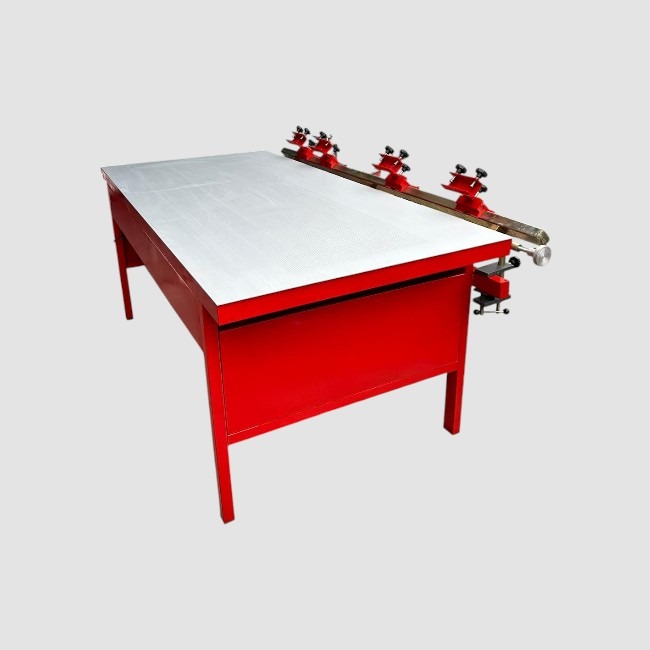

Desktop 4-Color 1-Station Screen Printing Machine
30,000.00 ₺ VAT Included
The 4-Color, 1-Station Screen Printing Press is designed for manual printing of up to four colors on textiles such as t-shirts and tote bags. While the four die arms rotate, the 35 x 50 cm printing table remains stationary. This design ensures the product maintains its position on the table, allowing the color dies to be printed sequentially.
Color Capacity: 4 colors
Printing Station: 1 unit
Table dimensions: 35 × 50 cm
Table Movement: Fixed
Molding Arms: Four rotary arms
Operating System: Manual
User Capacity: One person
Installation Type: Desktop
Warranty: 2 years
Technical Documentation
You can review the product’s technical specifications, dimensions and operating details in the PDF catalogue.
Description
What is a 4-Color, 1-Station Screen Printing Machine?
Screen Printing Machine, 4 Colors, 1 Station; It is a desktop printing system designed for manual screen printing of up to four colors onto textile products such as t-shirts, tote bags, and similar items.
The machine has four rotary die arms and one fixed printing table. The textile product to be printed is placed on the fixed table, which measures 35 × 50 cm. The die, prepared for each color, is sequentially brought to the printing position using the rotary arms.
Thanks to its single-station design, the machine can be operated by a single operator. Its compact desktop design facilitates the setup of four-color printing layouts in small workshops and with limited production space.
Technical Specifications
| Feature | Value |
|---|---|
| Product type | Manual desktop screen printing press |
| Color capacity | 4 colors |
| Printing station | 1 piece |
| Table dimensions | 35 × 50 cm |
| Table movement | Still |
| Mold arms | Four rotating arms |
| Working system | Manual |
| User capacity | Single operator |
| Installation type | Desktop |
| Guarantee | 2 years |
| Manufacturer | OkanGökhan Machinery |
How do the four rotary die arms work?
A screen printing stencil, prepared for a different color, can be attached to each of the four rotating arms on the machine. When it's time to print, the corresponding arm is rotated onto the fixed table, and manual printing is performed.
After the first color is printed, the platen arm is lifted and the arm prepared for the next color is brought to the printing position. Since the product remains on a fixed table, the basic position of the printing surface is maintained.
In a four-color design, a separate mold must be prepared for each color. For suitable mold options, please refer to the following: screen printing plates You can check it out.
A Station and Fixed Table Structure
A single station means that only one textile product can be on the printing table at a time. The product is placed on a 35 × 50 cm table, and the colors are printed sequentially onto the same product.
While the table remains stationary, the four plate arms rotate on the table. This working arrangement allows four different color plates to be used in a single printing station.
The 35 × 50 cm measurement refers to the outer dimensions of the printing plate. The actual maximum printing area may be smaller depending on the product structure, the outer dimensions of the plate, the pattern position, and the spacing between connections.
Exposure in Multicolor Printing
In multi-color printing, each plate must correctly match the other colors in the design. Color separation, film placement, plate preparation, and manual exposure processes must be carefully performed before printing.
This model features four rotary die arms, but the current technical specifications do not mention a micro-positioning system. Therefore, precise color matching must be achieved through die placement and operator adjustments.
Before starting mass production, a test print should be made to check the consistency of all colors and to finalize the settings.
The Function of Springs and Tension Arms
The spring and tension mechanism in the mold arms helps to raise the arm in a controlled manner and adjust the working position. The arm movement should be controlled according to the weight of the mold and the working procedure.
Mold connections, springs, and moving parts should be checked at regular intervals; loose connections should be tightened before production continues.
Which products can be printed on?
Screen Printing Machine, 4 Colors, 1 Station, With appropriate table and product placement, it can be used in the following textile applications:
- T-shirt prints
- Fabric bag prints
- Pieces of fabric
- Promotional textile products
- Aprons and work clothes
- Small and medium-sized textile panels
- Sample and low-volume multi-color productions.
The product must be placed evenly and tautly on the printing plate. An appropriate fastening method should be used to prevent ink from seeping between the fabric layers and to minimize product movement during printing.
Paint, Mold, and Squeegee Selection
In textile printing, a dye system suitable for the fabric type and background color must be used. The same printing base or application pattern may not be suitable for light and dark fabrics.
For water-based product options water-based textile dyes You can check it out.
The mesh value should be selected according to the pattern detail, ink viscosity, and desired ink thickness. This will be used during printing. screen printing squeegee Width, stiffness, and pressure angle also affect the result.
Who is it suitable for?
- Small and medium-sized textile printing workshops
- Manufacturers who want to print designs in up to four colors.
- Businesses that perform manual production with a single operator
- Users looking for a compact desktop workbench
- Companies that do t-shirt and tote bag printing.
- Sample and personalized product manufacturers
- Workshops just starting out in screen printing
The Difference Between a One-Arm and a Four-Color Loom
The single-arm printing press is suitable for using one plate at a time. In the four-color, one-station model, four different plates can be kept ready on the machine and brought to the printing position sequentially with the rotary arms.
For monochrome works one-sleeved t-shirt printing machine or screen printing desktop printing apparatus You can check it out.
For jobs requiring automatic squeegee movement. semi-automatic screen printing machine assessable.
For all models screen printing machines category You can visit.
Intermediate Drying Between Prints
In multi-color textile printing, intermediate drying may be necessary after one color is printed before moving on to the second plate. The need for intermediate drying depends on the dye system, print thickness, and the degree to which the colors come into contact with each other.
After all printing is complete, a fixation process must be applied under the temperature and time conditions specified by the ink manufacturer. For suitable equipment options, please refer to the following: screen printing drying systems You can check it out.
Important Considerations During Installation and Use
- The workbench must be fixed to a sturdy and stable table.
- The range of motion for all four mold arms must be left undisturbed.
- The product should be placed evenly and consistently on the printing table.
- A separate mold must be prepared for each color.
- Color exposure should be checked before production.
- Mold connections and spring mechanisms should be inspected regularly.
- A sample print should be made on the actual product before mass production.
Technical Catalog
You can review the structure, dimensions, and usage details of the workbench in the PDF catalog below:
Technical Catalog of 4-Color 1-Station Screen Printing Machine (PDF)
Delivery, Warranty and Technical Support
Screen Printing Machine, 4 Colors, 1 Station, The product is prepared according to stock and order availability. Current stock and delivery time should be confirmed before placing an order.
The table where the workbench will be set up, the range of motion for the handles, the patterns to be used, and the dimensions of the textile products should all be evaluated before placing an order.
The product comes with a 2-year warranty. For information on installation, usage, and technical support, please contact us. You can contact OkanGökhan Makina..
Frequently Asked Questions About the 4-Color, 1-Station Screen Printing Machine
How many mold arms are there in the machine?
The machine has four rotating die arms. A die prepared for a different color can be attached to each arm.
Does the tray rotate?
No. The 35 × 50 cm printing plate is fixed. Four plate arms rotate sequentially on the plate.
How many products can be printed at the same time?
The machine is single-station and only one product is on the printing table at a time. Colors are printed sequentially on the same product.
How many molds are needed for four-color printing?
A separate screen printing dies are required for each color. For a four-color design, typically four separate dies are prepared.
Is 35x50 cm the printing area?
The dimensions of the 35 × 50 cm printing table are as follows. The actual printing area may be smaller depending on the product, plate, and connection distances.
Can the machine be used by one person alone?
Yes. The manual system is designed to be used by a single operator.
Is drying necessary between colors?
Depending on the paint system and print thickness used, intermediate drying may be required. The paint manufacturer's application instructions should be followed.
Does the product have a warranty?
Yes. The Desktop 4-Color 1-Station Screen Printing Press comes with a 2-year warranty.
For information on selecting workbench, mold, and paint: Get a quote and technical support..
Related products

Screen Printing Paint Drying Rack (RAYK)
28,200.00 ₺ VAT Included
Screen Printing Vacuum Manual Printing Machine
35,400.00 ₺ VAT Included
T-shirt Printing Machine – Screen Printing Single Arm Printing Apparatus
12,000.00 ₺ VAT Included