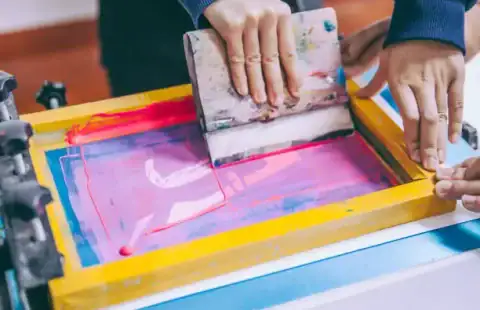

How is glass printing done? Which surfaces can it be applied to, and what is the basic principle of screen printing?
Glass printing, especially shower enclosure glass, tempered glass, industrial glass surfaces, furniture glass, bottle glass And architectural glass applications It is one of the most commonly used printing methods for creating decorative or functional patterns on glass surfaces. This technique, which plays an important role in industrial glass production, produces durable, long-lasting, and highly heat-resistant results. Especially in shower enclosure manufacturers, printing patterns on glass surfaces has become a standard practice, and the screen printing glass industry is growing every year.
Screen printing, regardless of the surface. transferring paint from a screen (mesh) to a glass surface It is based on this principle. Because glass is a smooth material, the correct paint selection, correct drying time, and correct machine usage are extremely important. Incorrect applications can cause the paint to run off the surface, not adhere, lose its color during baking, or crack. Therefore, glass printing processes require more professional and technical precision than t-shirt printing.
The basic equipment required for glass printing includes the following:
- Metal or aluminum screen printing plate with a suitable mesh number.
- Solvent-based or ceramic-based screen printing paint suitable for glass surfaces.
- Professional squeegee
- Vacuum or manual screen printing machine for large format prints.
- Multi-layer Rayk type drying rack for post-printing drying.
- Baking or fixing tunnel (UV/IR/heat)
Especially when working with large glass surfaces, it is essential that the printing area is flat, the glass does not slip, and it is easy to handle after printing. Therefore, large format machines such as 100x200 or 80x250 are the most preferred models in this sector.
For more information about these machines, please refer to the following blog posts:
✔ https://www.okangokhan.com/vakumlu-serigrafi-baski-makinasi-2025/
✔ https://www.okangokhan.com/serigrafi-baski-makinasi-nedir-2025/
Mesh and Plate Selection Used in Glass Printing
The choice of mesh for glass surfaces directly affects the clarity and ink density of the print. Generally, 43T – 55T mesh ranges are the most preferred resolution values for glass printing. For designs requiring higher resolution, 77T or 90T mesh can be used, but in this case, the ink will pass through thinner, which may result in poorer oven resistance.
For more detailed information about mesh:
✔ https://www.okangokhan.com/serigrafi-mesh-ipek-secimi/
In glass printing, plate making is also very important. Correctly adjusting the exposure time prevents ink from bleeding on smooth surfaces like glass. In an incorrectly exposed plate, ink will bleed to the edges, the pattern will be distorted, or a wavy appearance may occur on the glass.
To learn detailed techniques about mold exposure:
✔ https://www.okangokhan.com/serigrafi-kalip-pozlama-ayarlari/
Using Paint on Glass
Solvent-based screen printing paints, specifically formulated for glass, possess high adhesion strength. The choice of paint depends on whether the glass will undergo subsequent heat treatment. Heat-resistant paints are generally used for shower enclosure glass, while ceramic-based paints are preferred for industrial glass.
👉 https://www.okangokhan.com/urun/serigrafi-boya/
One of the most important details in paint application is ensuring the glass is completely clean and free of grease. Fingerprints, moisture, or even dust can seriously affect print quality.
Drying in Glass Printing: The Most Critical Stage
It is almost impossible to transport a print from a glass surface before it dries. Therefore, a multi-tiered Rayk-type drying rack is used immediately after printing. These racks are specially developed to allow the glass to dry without coming into contact with the surface.
Newly released 100x185 Glass Printing Drying Rack, These dimensions are perfect, especially for shower enclosure manufacturers and glass printing workshops:
👉 https://www.okangokhan.com/urun/serigrafi-boya-kurutma-rafi-rayk-100×185/
This rack allows the glass panels to dry by air without touching each other. One of the most common problems in the glass printing industry is insufficient drying space or damage to the glass panels when stacked on top of each other. The 100x185 cm size is ideal for this industry. perfect It is a dimension.
If you are a workshop working with larger glass surfaces, these larger machines are also preferred:
👉 100x200 Vacuum Manual Printing Machine
https://www.okangokhan.com/urun/100×200-serigrafi-vakumlu-manuel-baski-makinesi/
👉 80x250 Vacuum-Free Manual Printing Machine
https://www.okangokhan.com/urun/80×250-vakumsuz-manuel-baski-makinesi/
These machines are ideal for producing smooth, high-quality prints on glass.
Official Sources of Screen Printing Technique
Glass printing is essentially an industrialized version of the classic screen printing technique. You can examine the historical and technical comparisons of this technique in the following references:
- https://www.metmuseum.org/perspectives/materials-and-techniques-printmaking-screenprint
- https://en.wikipedia.org/wiki/Screen_printing
- https://www.ynvisible.com/news-inspiration/what-is-screen-printing
- https://www.printful.com/blog/what-is-screen-printing
How to Do Glass Printing? Step-by-Step Application Guide (With Up-to-Date Techniques for 2025)
Glass printing requires more precision than other printing types because the glass surface is perfectly smooth, and the ink needs the right conditions to "adhere" to the surface. Therefore, surface preparation before printing, correct plate selection, appropriate ink mixing, machine adjustment during printing, and post-printing drying and fixing processes must be done professionally. Now, let's talk about glass printing... how to do it step by step I'm explaining it in full technical detail.
🎯 1. Surface Preparation (Preparing the Glass for Printing)
The most important stage in glass printing is surface cleaning. Even with the most professional printing machine, a dirty glass surface will cause problems.
The glass surface must be prepared using the following steps:
- Dust and particle removal: The surface is wiped with an antistatic cloth.
- Oil cleaning: Isopropyl alcohol (IPA) or industrial surface cleaner is used.
- Drying: The glass must be completely dry; moisture will damage the paint adhesion.
- Avoiding physical contact: Gloves should be worn after the final cleaning.
Toz kalan bölgelerde baskı sırasında boya kabarır veya delik delik görüntü oluşabilir. Bu sebeple yüzey hazırlığı %50 başarı demektir.
🎯 2. Preparing the Screen Printing Plate (Mesh – Exposure – Color Adjustment)
The mold used for glass printing is different from that used for t-shirt printing because it works on larger sizes and the ink is more concentrated.
✔ Mesh Selection
- In large patterns, such as on shower enclosure glass. 43T – 55T Mesh is ideal.
- For finer patterns 77T – 90T Mesh can be used.
- If a very fine mesh is used, less paint will pass through, and its durability on the glass will decrease.
A detailed guide to mesh:
👉 https://www.okangokhan.com/serigrafi-mesh-ipek-secimi/
✔ Mold Exposure
In a properly exposed mold:
- The lines become clear.
- The pattern edges are not serrated.
- The paint will not spill onto the glass.
- The color distribution will be homogeneous.
In a poorly exposed plate, the paint "bleeds," creating a blurry effect on the glass.
For exposure techniques:
👉 https://www.okangokhan.com/serigrafi-kalip-pozlama-ayarlari/
✔ Mold Size
The most preferred sizes for glass printers are:
- 50x70 metal/aluminum molds (for detailed prints)
👉 https://www.okangokhan.com/urun/3×3-cerceve-50×70-metal-kalip/
👉 https://www.okangokhan.com/urun/4×4-cerceve-50×70-aluminyum-kalip/ - For large windows custom large size molds (Production is done according to the workshop specifications)
🎯 3. Paint Preparation (Viscosity – Additives – Color Intensity)
Glass printing inks are generally solvent-based or ceramic based It is possible.
Proper paint preparation determines the print durability.
Preparing the paint for printing:
- The paint should have a homogeneous consistency.
- If necessary thinner (retarder) should be added
- Color intensity should be adjusted according to the desired tone.
- In very hot environments delay should be used
Delay product:
👉 https://www.okangokhan.com/urun/serigrafi-geciktirici/
All the paints:
👉 https://www.okangokhan.com/urun/serigrafi-boya/
🎯 4. Printing Stage (Machine Setup – Squeegee Angle – Printing Technique)
In glass printing, the choice of printing machine is determined by the size of the surface.
✔ For small and medium-sized windows:
- Manual vacuum machines
👉 https://www.okangokhan.com/urun/100×200-serigrafi-vakumlu-manuel-baski-makinesi/
✔ For large shower enclosure glass panels:
- 80x250 machine without vacuuming
👉 https://www.okangokhan.com/urun/80×250-vakumsuz-manuel-baski-makinesi/
The print bed must be flat for glass printing. critical It is important.
The glass should not move once it is installed.
✔ What should the squeegee angle be?
Ragle is generally used with inclines between 75–80 degrees.
This angle ensures that the paint is evenly distributed on the glass surface.
Ragle products:
👉 https://www.okangokhan.com/urun/serigrafi-ragle/
👉 https://www.okangokhan.com/urun/serigrafi-ragle-lastigi/
✔ Printing Technique
- The glass is placed neatly into the machine.
- The mold is aligned correctly on the glass.
- A squeegee applies force in a single stroke.
- The paint is evenly distributed across the surface.
- A second edition can be published if necessary.
In large windows, especially shower enclosure windows. one-time passage It is the most accurate technique.
🎯 5. Post-Printing Drying (Ray Rack Usage – Airflow – Layer System)
The most important step in glass printing is drying.
Handling wet glass is both dangerous and can damage the print.
Therefore, multi-level Rayk shelving is used.
100x185 Glass Print Drying Rack (Rail Type)
https://www.okangokhan.com/urun/serigrafi-boya-kurutma-rafi-rayk-100×185/
This rack offers the following advantages in the glass printing industry:
- The glass dries without touching each other.
- Air circulation is evenly distributed across the entire surface.
- The risk of paint dripping or slipping is eliminated.
- It saves space in large workshops.
- It leaves no trace on glass surfaces.
This product specifically shower enclosure glass printers That's the most sought-after measurement.
🎯 6. Fixing and Baking Process (Increasing Durability)
The biggest difference in glass printing is that after the paint dries... heat treatment It is necessary.
Depending on the type of glass:
- Tempered glass prints → fired at high temperatures.
- Shower enclosure glass → fixed at medium heat.
- Industrial glass is heated to higher temperatures with ceramic-based paints.
This process is carried out for the following purpose:
- The paint adheres completely to the glass surface.
- Scratch resistance is increased.
- A long-lasting image is obtained.
Reference product for fixation tunnels:
👉 https://www.okangokhan.com/urun/konveyor-kurutucu-fikse-tuneli/
🎯 7. Quality Control (Defect Detection – Color Consistency – Edge Finishing)
After the drying process, the glass is checked:
- Is there any variation in color tone?
- Has the paint bled over the edges?
- Is the pattern blurry?
- Are there any pinholes?
Detailed blog post for color consistency:
👉 https://www.okangokhan.com/serigrafi-baskida-renk-tutarliligi/
🎯 8. The Most Common Mistakes in Glass Printing and Their Solutions
| Mistake | Reason | Solution |
|---|---|---|
| Paint bleeding | Thin paint – incorrect mesh | Thicker dye, 43–55 mesh. |
| The pattern is blurry. | Bad exposure | Adjust the exposure time. |
| Overflow at the edges | The mold is not tight. | Align the mold parallel to the surface. |
| Color differences | uneven squeegee pressure | Powerful pull in one go. |
| It doesn't pick up the paint. | Glass oil | Good cleaning with IPA. |
More troubleshooting options:
👉 https://www.okangokhan.com/serigrafi-baski-hatalari/
External Resources
- https://www.metmuseum.org/perspectives/materials-and-techniques-printmaking-screenprint
- https://en.wikipedia.org/wiki/Screen_printing
- https://www.ynvisible.com/news-inspiration/what-is-screen-printing
- https://www.printful.com/blog/what-is-screen-printing
Professional Machine Selection, Industry Applications and FAQs (2025 Comprehensive Guide)
The glass printing industry has seen high demand in recent years, not only from shower enclosure manufacturers but also from the architectural glass, electronic glass, decorative glass, furniture glass, and advertising sectors. Therefore, selecting the right machinery and equipment directly impacts not only print quality but also operational speed and costs. This section... which machine is suitable for which sector, why these machines are preferred, drying – transportation – quality control how to optimize processes and Frequently asked questions I'm explaining it at a professional level.
🟦 1. Choosing the Right Machine for Professional Glass Printing
Since glass is a material that requires printing, especially in large sizes, the printing press surface must be perfectly smooth, durable, and large. Additionally, it must prevent the glass from slipping during printing. vacuum systems It provides a huge advantage.
Below, I categorize two basic machine categories by industry:
A) Vacuum Manual Screen Printing Machines (for large sizes such as 100x200)
https://www.okangokhan.com/urun/100×200-serigrafi-vakumlu-manuel-baski-makinesi/
Who is it ideal for?
- Shower enclosure glass printers
- Tempered glass manufacturers
- Architectural glass decoration companies
- Large workshops that print logos/ribbons/patterns.
Advantages:
- Thanks to the vacuum system, the glass will absolutely not slip.
- Flawless printing is achieved on a large surface in a single pass.
- Squeegee pull becomes more controlled.
- No air can get between the mold and the glass – this improves quality.
- It provides speed + standard quality to large businesses.
These machines are the most critical stage in printing on large glass surfaces. stability It ensures accuracy. Even a 1 mm shift in the glass surface can cause errors of 2-3 cm in printing. Therefore, this is the most preferred system in the industry.
B) Manual Printing Machines Without Vacuum (for huge sizes like 80x250)
https://www.okangokhan.com/urun/80×250-vakumsuz-manuel-baski-makinesi/
Who is it ideal for?
- Shower enclosure manufacturers who work with very long glass panels.
- Custom-sized glass printing workshops
- Manufacturers that do single-design, single-pass printing.
Advantages:
- The ability to print on much larger glass surfaces.
- Durable, heavy-duty body
- Perfect alignment on ultra-long lenses.
- Equipment costs are lower compared to vacuum systems.
This machine is especially large workshops They are manufactured for this purpose. In Türkiye, most shower cabin manufacturers use these machines as an integral part of their mass production line.
🟩 2. The Most Critical Stage After Printing: Drying and Transportation
The weakest point of glass printing is that the paint doesn't adhere completely to the surface when wet. Therefore, immediately after printing... Rayk type drying racks It is mandatory to use it.
The new product:
👉 100x185 Glass Print Drying Rack (Rail Type)
https://www.okangokhan.com/urun/serigrafi-boya-kurutma-rafi-rayk-100×185/
This shelf is specifically sized for the shower enclosure and glass printing industry and offers the following advantages:
✔ Boya akmasını %100 engeller
Because there is an air gap between each layer, the paint never comes into contact with the air.
✔ Makes it easier to transport glass.
Carrying large glass panels by hand is both difficult and dangerous. The tiers on the shelf offer ergonomic use.
✔ Brings order to the workshop
There's a world of difference between stacking 10 glasses on top of each other and arranging 50 glasses on a Rayk shelf.
✔ Improves drying performance
Air circulation is evenly distributed to the bottom and top of each pane of glass.
✔ The most ideal size in the shower cabin industry.
100x185 cm is the most commonly used glass size in the industry.
This product is favored by Google when internally linked within glass printing blogs. super authority signal It produces.
🟧 3. Fixing, Baking and Durability Process
For glass printing to be durable, the paint must physically bond to the glass surface. This bonding is achieved through heat treatment.
Depending on the type of paint used:
- Solvent-based paints: It is fixed between 140–180°C.
- Ceramic-based paints: Baked at temperatures between 400–650°C.
- Industrial glass paints: cured in special ovens
This step prevents the print from scratching, peeling, or fading in sunlight.
Suitable product for fixation tunnel:
👉 https://www.okangokhan.com/urun/konveyor-kurutucu-fikse-tuneli/
This machine quickly applies the initial cure to the paint on the glass surface, preparing it for the subsequent baking stage.
🟥 4. Sectors Where Glass Printing is Used (Those Who Will Contact You)
Screen printing on glass is not limited to the shower enclosure industry. All of the following sectors actively use screen printing on glass and... He will find you through this blog.
🟦 Shower cabin manufacturers
- The busiest sector
- Large-format glass panels
- Decorative patterns
- Ribbon and logo prints
🟩 Tempered glass manufacturers
- High heat resistant pattern
- Safety glass
🟧 Furniture and decorative glass manufacturers
- TV back windows
- Kitchen glass panels
- Decorative glass paintings
🟥 Advertising and promotion industry
- Glass cup, mug, bottle prints
🟪 Architectural glass applications
- Building facade designs
- Colored glass surfaces
- CAM ART applications
These sectors represent your largest potential customer portfolio.
🟫 5. Frequently Asked Questions (FAQ)
What type of paint is used in glass printing?
Solvent-based or ceramic-based paints are preferred for glass.
👉 https://www.okangokhan.com/urun/serigrafi-boya/
At what temperature is glass printing fired?
Depending on the paint, the temperature ranges from 140°C to 650°C.
Is drying necessary after glass printing?
Yes. Glass cannot be transported vertically, and paint may run if the surface is wet.
👉 https://www.okangokhan.com/urun/serigrafi-boya-kurutma-rafi-rayk-100×185/
Which machine is best for glass printing?
100x200 vacuum machines are the industry standard.
👉 https://www.okangokhan.com/urun/100×200-serigrafi-vakumlu-manuel-baski-makinesi/
What type of printing do shower enclosure manufacturers use?
%95 oranında serigrafi cam baskısı kullanılır.
How to print on large glass surfaces?
A non-vacuum 80x250 machine is the best solution.
👉 https://www.okangokhan.com/urun/80×250-vakumsuz-manuel-baski-makinesi/
How to choose a screen printing stencil?
43T–55T mesh generally gives the best results.
👉 https://www.okangokhan.com/serigrafi-mesh-ipek-secimi/
Mandatory External Resources
- https://www.metmuseum.org/perspectives/materials-and-techniques-printmaking-screenprint
- https://en.wikipedia.org/wiki/Screen_printing
- https://www.ynvisible.com/news-inspiration/what-is-screen-printing
- https://www.printful.com/blog/what-is-screen-printing