
Screen Printing Machine Selection: Vacuum–Manual Models, Prices and 2026 Guide
CHAPTER 1: What is a Screen Printing Press? The Structure and Usage Principles of Screen Printing
A screen printing press is the most fundamental piece of equipment in a screen printing system and the main platform that determines the accuracy, alignment, and stability of the entire printing process. No matter how good the ink, plate, squeegee, or mesh used in screen printing, if there isn't a proper screen printing press, the print quality will never reach a professional level. Therefore, a screen printing press is not just a piece of equipment; it is the backbone of printing and the most critical component of the production process.
So what is a screen printing press? Technically, a screen printing press is a mechanical platform that ensures the screen printing plate is fixed at the correct angle, the printing surface is centered, and the squeegee operates at the correct printing angle. Although there are many types of screen printing, from manual presses to fully automatic machines, the basic working principle of all these systems is based on the same press principle. The press ensures that the fabric, paper, glass, or metal surface is held motionless during printing and that the plate makes simultaneous contact with the surface.
One of the reasons screen printing is so widespread, especially in Türkiye and worldwide, is that screen printing presses can be adapted to manufacturers of all sizes. While fully automatic CNC-controlled machines are available for large factories, desktop or freestanding manual presses may suffice for small printing workshops. This makes screen printing both an economical and accessible production method.
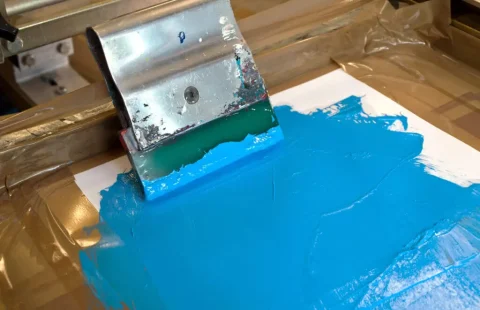
To understand the basic function of a screen printing press, it's necessary to first look at how screen printing works. In screen printing, ink is transferred to the surface through a fine-textured mesh. The plate is prepared on this mesh, the film is exposed, and ink passes through the exposed areas of the pattern. The squeegee then distributes the ink evenly across the mesh, ensuring a homogeneous and high-quality print. This is where the press comes in: it fixes the plate, stabilizes the surface, and guarantees the accuracy of the print.
In simpler terms: Quality printing = quality press + quality plate + the right ink + the right squeegee.
There are different types of screen printing machines:
1. Manual Screen Printing Machines
Ideal for beginners or small manufacturers, these types of machines are operated entirely manually. The press table is fixed, and the die arm moves up and down. One of the best-known and most widely used models is the classic single-arm manual machine.
For example:
➡ Screen Printing Machine, 4 Colors, 1 Station
These types of presses are the most basic entry-level equipment for t-shirt printers.
2. Manual Machines Without Vacuum
Non-vacuum printing presses are particularly suitable for manufacturers who want to screen print on large surfaces. On these presses, the printing surface is not held by vacuum; they are ideal for non-textile applications, banner printing, or large-surface materials.
Example:
➡ 80x250 Vacuum-Free Manual Printing Machine
3. Vacuum Manual Screen Printing Machines
Vacuum printing presses are essential tools for professional screen printing. Thanks to the vacuum system, the printing surface is fixed to the print bed without any air gaps. This allows for stable printing on all types of surfaces, including paper, PVC, foil, glass, and wood, without slipping.
This product is of special importance to your brand:
➡ Manual Vacuum Screen Printing Machine
In addition, for larger sizes:
➡ 70x200 Vacuum Screen Printing Machine
➡ 100x200 Vacuum Screen Printing Machine
Vakumlu tezgahlar özellikle cam baskı, ahşap baskı, tabela baskısı, kutu baskısı ve endüstriyel serigrafi üretiminde vazgeçilmezdir. Kumaş dışında çalışan firmaların %90’ı vakumlu tezgah tercih eder.
4. Desktop Screen Printing Machines
For hobbyists, small brands, or boutique textile workshops, the most economical solution is desktop looms. They take up little space and are practical to use.
Example:
➡ Screen Printing Desktop Printing Apparatus
5. Freestanding Screen Printing Machines
Freestanding presses are ideal for mobile use and medium-scale production. The printing table stands upright independently of the body, and the die holder is fixed accordingly.
Example product:
➡ Screen Printing Stand
6. T-shirt Printing Machines
It includes printing tables and stations specifically designed for textile production. High-volume printing is achieved quickly and efficiently.
Product:
➡ T-shirt Printing Machine
These machines are usually preferred in multi-station configurations, such as octopus-type printing presses.
Why is the screen printing machine so critical?
Because the workbench determines the accuracy, angle, and stability of the print.
A low-quality countertop:
- It slips during printing.,
- It causes centering errors.,
- It distorts the squeegee angle.,
- It makes the mold's contact with the surface uneven.,
- It makes the paint distribution uneven.,
- It creates adjustment problems during long-term production.
A professional press ensures flawless printing.
Things to consider when buying a screen printing press:
- Table thickness
- Vacuum power (if any)
- Mold holder quality
- Height adjustment
- Side cover adjustments
- Material durability
- Stability in long-term production.
These features make a difference in professional production.
CHAPTER 2: Types of Screen Printing Machines, Technical Differences, Professional Applications, and the Unrivaled Advantages of Vacuum Machines
A screen printing press is one of the most critical pieces of equipment determining print quality. The right press directly affects the clarity of the print, zero-slip operation, even ink distribution, and production speed. Therefore, professional manufacturers pay attention not only to price but also to numerous technical details such as stability, material quality, vacuum power, table structure, plate holder systems, and suitability for production volume when choosing a press. Because the better the press, the easier it becomes to achieve a flawless print result. This section will discuss the types of screen printing presses, which press is suitable for which business, and especially advantages in vacuum machines I explain everything in detail. I also highlight the products on your site for each countertop type in the right places, guiding the user on which model to choose.
1. MANUAL SCREEN PRINTING MACHINES AND THEIR APPLICATION AREAS
Manual presses are the most basic solution for screen printing. They are ideal for small print jobs, t-shirt printing, sample work, and low-volume production. On these presses, the printing arm is raised and lowered manually, the squeegee is pulled manually, and the surface is fixed to apply the print.
In Türkiye, those new to screen printing often initially opt for manual machines. This is because they are easy to set up, require no maintenance, and provide the ideal platform for learning the printing process.
One of the featured products:
➡ Screen Printing Machine, 4 Colors, 1 Station
This machine is particularly preferred in textile printing jobs where there are many colors. Despite being a single station, its ability to accommodate 4 color plates provides a significant advantage for beginner workshops. It is ideal for small brands, boutique manufacturers, or users who want to try screen printing for the first time.
Advantages of manual looms:
- Low cost
- Easy to use
- Takes up little space
- Ideal for education and learning.
- Sufficient performance for simple printing tasks.
However, manual machines also have limitations. The printing area is usually limited, speed can decrease in high-volume production, and maintaining the material surface stability depends entirely on the operator's skill.
2. STANDING MACHINES AND THEIR ROLE IN MOBILE PRODUCTION.
Freestanding screen printing presses are a step up from manual presses, offering a more professional level of printing. Thanks to their elevated base, these presses provide more stable printing. Particularly in recent years, freestanding presses have become quite popular for glass photo printing, wooden box printing, and large-surface products.
This design provides the printing operator with a wider range of motion. Companies engaged in industrial production, in particular, prefer floor-standing presses because they offer the ergonomic possibility of working standing up during long printing sessions.
One of the most successful models on the site:
➡ Screen Printing Stand
This product is suitable for both textile and non-textile printing. The stable structure of the print bed, the strong clamping mechanism of the plate holder, and the long-term stability are the most sought-after features by professional users.
3. DESKTOP SCREEN PRINTING MACHINES – THE MOST PRACTICAL SOLUTION FOR HOBBY AND MINI WORKSHOPS
Desktop screen printing presses are the ideal solution for users with small workspaces. They are particularly popular among designers who create custom t-shirts, small logo prints, samples, and personalized products.
Featured model:
➡ Screen Printing Desktop Printing Apparatus
This model is very advantageous in terms of both price and compact design. It is the most suitable option for small businesses, students, and designers working from home. Desktop workbenches generally offer very practical solutions for low-volume jobs.
Advantages:
- It takes up very little space.
- Budget-friendly
- Quick setup
- Ideal for small-scale production.
- Mobile working option
The only drawback is that it doesn't offer enough space for large-scale prints or industrial applications.
4. PROFESSIONAL APPLICATION OF T-SHIRT PRINTING MACHINES AND MULTI-COLOR.
T-shirt printing machines are among the most critical pieces of equipment in the textile industry. These machines provide a fast printing process, especially for textile products such as cotton t-shirts, hoodies, sweatshirts, sports jerseys, and tote bags. Many manufacturers start their textile operations with manual machines and then increase their capacity significantly by switching to multi-station machines.
Featured product:
➡ T-shirt Printing Machine
This press enables fast printing in both single-color and multi-color applications. The user lowers the plate, pulls out the squeegee, leaves it to dry, and can quickly move on to the second print. Speed and practicality are the biggest requirements in t-shirt production; t-shirt printing presses provide this.
In textile production, these looms generally operate as follows:
- Single-station models for small-scale production.
- 4–6 station models are for medium-scale production.
- Octopus machines are preferred for large-volume production.
These looms are indispensable, especially for entry-level textile brands.
5. NOW LET'S GET TO THE MOST CRITICAL TOPIC: VACUUM SCREEN PRINTING MACHINES
This section forms the heart of your product line. Because vacuum presses are at the heart of the screen printing world. a symbol of professionalism It is considered essential. For those who do non-textile screen printing, vacuum presses are almost indispensable equipment.
But why?
What is a vacuum screen printing press used for?
The vacuum system essentially glues the surface to the build plate during printing. There are no air gaps on the surface, and no slipping or stretching occurs. This means:
✔ %100 sabit baskı yüzeyi
✔ Zero slippage and alignment issues.
✔ Flawless results in highly detailed work.
✔ Complete consistency, even on large surfaces.
This feature makes vacuum machines indispensable in the following sectors:
- Glass printing
- Woodblock printing
- Metal sheet printing
- PVC materials
- Plexiglass printing
- Poster and sign production.
- Industrial screen printing
- Electronic circuit boards (PCBs)
- Packaging printing
- UV screen printing applications
This is why vacuum machines are unrivaled in professional manufacturing.
Our products:
1) Standard vacuum presses such as 50×70 – 60×80 – 70×100
➡ Manual Vacuum Screen Printing Machine
This product is one of the most preferred professional printing presses in Türkiye.
Advantages it offers:
- Powerful vacuum motor
- Even airflow across the plate.
- Fastening even in thick materials.
- Quiet operation
- Non-returnable mold holder system.
- Durable body structure
Glassmakers, sign manufacturers, and box packaging companies, in particular, prefer this model.
2) 70×200 Vacuum Screen Printing Machine
➡ 70x200 Vacuum Manual Printing Machine
This model is designed for large-scale printing.
Who prefers it?
- Sailing flag manufacturers
- Major sign manufacturers
- Glass factories
- Businesses that print on long surfaces
- Industrial production facilities
200 cm length is a highly sought-after size in the professional screen printing world.
3) 100x200 Professional XL Vacuum Cleaner
➡ 100x200 Vacuum Manual Printing Machine
This model is designed for businesses that want to print on large surfaces.
There are very few brands in Türkiye that produce machinery of this size; therefore Your product holds a unique position in the industry..
Areas of application:
- Large glass sheets
- Industrial panel prints
- Large pieces of furniture
- advertising panels
- Woodblock prints
- Decorative prints after CNC cutting.
These workbenches are unrivaled for professional firms demanding high stability.
6. NON-VACUUM MACHINES AND THEIR APPLICATION AREAS
Non-vacuum screens also play an important role in screen printing.
Featured model:
➡ 80x250 Vacuum-Free Manual Printing Machine
This model is particularly preferred for banner printing and large-surface jobs.
It is the most suitable solution in terms of cost-performance.
7. PROFESSIONAL CRITERIA WHEN CHOOSING A MACHINE TOOL
When a customer visits your website, they are looking for answers to these questions:
❓ Which workbench is right for my job?
❓ Should I buy a vacuum cleaner countertop?
❓ Which measurement would be sufficient?
Professional criteria for answering these questions:
- The type of material to be printed on.
- Printing area width
- Production volume
- Multicolor or monochrome printing?
- Textile or industrial?
- Need for fixation (vacuum)
- Number of operators and workflow
CHAPTER 3: Screen Printing Machine Selection, Comparisons, User Errors, Price Analysis, 2026 Trends and Professional FAQs
For a user deciding to purchase a screen printing press, the most critical step is choosing the right press for the right job. This is because the press directly affects not only print quality but also production speed, operating costs, workflow stability, and annual profitability. The market offers many types of presses: manual, floor-standing, desktop, vacuum, non-vacuum, textile-specific, and industrial. To make the right decision among so many options, it's necessary to clearly understand how to compare the presses, which production areas they are suitable for, which common problems occur, and how prices vary. This section provides all the information a user looking to buy a screen printing press will need, presented in a professional language.
10 CRITICAL POINTS TO CONSIDER WHEN CHOOSING A SCREEN PRINTING MACHINE
The price or brand of a workbench alone is not enough to make the right choice. What matters is that the workbench is compatible with your business model.
Here are 10 essential criteria to know for choosing the right countertop:
1. Type of Material to be Printed
This criterion is the most decisive.
- Textiles such as t-shirts, hoodies, and bags → T-shirt printing presses
- Glass, wood, metal, PVC, plexiglass → Vacuum countertop
- Banners, posters, signs → Non-vacuum or large-scale vacuum bench
- Labels, thin film materials. → Machine tools with medium vacuum power
If printing is to be done on hard surfaces A vacuum machine is a necessity..
✔ Reference product:
➡ Manual Vacuum Screen Printing Machine
2. Printing Area Width
The printing dimensions of your job will determine the machine dimensions.
- 40x60 cm workpiece → Medium-sized workbench
- 50x70 jobs → Professional mid-range segment
- 70x100 and above → Industrial vacuum workbench
- 200 cm long jobs → 70×200 or 100×200 models
✔ For large surfaces:
➡ 70x200 Vacuum Manual Printing Machine
➡ 100x200 Vacuum Manual Printing Machine
3. Production Volume
The number of print jobs you will do daily determines the type of printing press you need.
- 10–50 prints per day → Manual press
- 50–200 prints per day → Floor-standing or desktop
- 200–500 prints per day → T-shirt stands
- 500+ prints per day → Semi-automatic systems
Manual systems will be insufficient for high volume operations, so the choice must be made carefully.
4. The Need for Multicolor Printing
If the prints are to be done in 2–4 colors, rotary head printing presses or 4-color systems are required.
✔ This is the ideal entry-level workbench for this purpose:
➡ Screen Printing Machine, 4 Colors, 1 Station
5. Vacuum Requirement
If the material to be printed is slippery, curls, or shifts slightly, a vacuum is necessary.
The benefits of a vacuum countertop:
- %100 sabit yüzey
- Zero detail errors.
- In very high-volume production, the settings cannot be misadjusted.
- There is no stretching on large surfaces.
Türkiye’de profesyonel cam ve tabela üreticilerinin %90’ı vakumlu tezgah kullanır.
✔ Offered models:
➡ Standard Vacuum Workbench
➡ 100x200 XL Vacuum Workbench
6. Work Area and Physical Layout
The workbench needs to fit the space in your studio or factory. For large workbenches, a working area of 2–3 meters is essential.
7. Operator Experience
Complex, adjustable workbenches may not be suitable for beginners.
Desktop models → get started
Freestanding or vacuum-mounted models → intermediate level
XL vacuum → professional
8. Mold Size and Workbench Compatibility
Workbench tops must be compatible with your existing molds. For example, a 60x80 workbench is ideal for a workshop using 40x60 molds.
9. Paint Type and Printing Technique
Techniques such as plastisol, water-based, and UV paints can create different countertop needs depending on their surface adhesion.
Vacuum printing presses are essential, especially for UV printing.
10. Long-Term Planning
Choose your workbench not just for today's business, but according to your growth plans.
Many businesses make the mistake of replacing their existing countertops later when they need an XL counter.
2. PROFESSIONAL COMPARISON OF MACHINE TOOL TYPES
Below, I clearly compare all countertop types, highlighting their advantages and disadvantages.
A. Desktop Workbench vs. Manual Workbench
| Feature | Desktop | Manual |
|---|---|---|
| Floor covering | Very little | Middle |
| Use | Easy | Middle |
| Price | Suitable | Middle |
| Production speed | Low | Middle |
| Professionalism | Low-Medium | Middle |
This comparison shows that desktop models are for entry-level users.
B. Manual Workbench vs. Freestanding Workbench
| Feature | Manual | Footed |
|---|---|---|
| Stability | Middle | High |
| Ergonomics | Middle | High |
| Request | Entry level | Intermediate level |
| Production | Small | Middle |
Freestanding workbenches are the first step towards a professional workshop.
C. Freestanding Workbench vs. Vacuum Workbench
| Feature | Footed | Vacuum |
|---|---|---|
| Professionalism | Middle | Very high |
| Anti-slip | None | %100 |
| Detail performance | Middle | Senior |
| Surface type | Textile-focused | Every surface |
| Production volume | Middle | High |
Vacuum countertops, when open, are the most professional option.
D. Vacuum Machine vs XL Industrial Machine
| Feature | Standard Vacuum | XL Vacuum |
|---|---|---|
| Surface area | Middle | Very big |
| Sector | General screen printing | Industrial |
| Production speed | High | Very high |
| Investment | Middle | High |
These models are preferred by advertising factories, glass manufacturers, and furniture production facilities.
3. HOW ARE SCREEN PRINTING MACHINE PRICES DETERMINED?
The main factors affecting screen printing press prices are as follows:
✔ Countertop dimensions
✔ Whether or not it's vacuum-infused
✔ Quality of the motor and mechanism used
✔ Body material (iron, steel, aluminum)
✔ Mold holding systems
✔ Height and angle adjustments
✔ Locally produced / imported product
✔ Whether it is industrial grade or not
General price ranges (based on 2025):
- Desktop: 2,000 – 6,000 TL
- Manual freestanding workbench: 7,000 – 20,000 TL
- Mid-range vacuum press: 30,000 – 55,000 TL
- 70x200 vacuum-packed: 70,000 – 120,000 TL
- 100x200 XL vacuum-packed: 120,000 – 190,000 TL
Note: These figures are industry averages, and you determine the prices on your website yourself.
4. MOST COMMON MISTAKES WHEN USING A SCREEN PRINTING MACHINE
Users often make the following mistakes:
❌ Choosing the wrong countertop size
❌ For jobs requiring vacuuming, it is preferable to use a workbench without a vacuum cleaner.
❌ Not tightening the mold holder completely (the mold will slip)
❌ Incorrectly adjusting the squeegee angle
❌ Not securing the print bed properly
❌ Using desktop workbenches in large-scale production
❌ Not rechecking the workbench settings after each job.
❌ Using unsuitable paint
These errors seriously affect print quality.
5. 2025 SCREEN PRINTING MACHINE TRENDS
With 2025, some trends in screen printing are rapidly gaining popularity:
⭐ 1. Demand for more powerful vacuum motors is increasing.
As glass and plexiglass printing increases, vacuum presses are becoming standard.
⭐ 2. The number of manufacturers shifting towards XL countertops is increasing.
The furniture, advertising, and glass industries require large-surface printing.
⭐ 3. Modular workbenches are gaining prominence.
Freestanding and desktop combination designs are gaining popularity.
⭐ 4. Industrial screen printing is growing.
Electronics, packaging, and engineering companies are increasing their investments in screen printing.
⭐ 5. Countertops suitable for UV paint are becoming increasingly important.
UV screen printing has become a trend, especially in plexiglass and PVC printing.
6. IN WHICH SECTORS ARE SCREEN PRINTING MACHINES USED?
- Textile
- Advertising agencies
- Glass factories
- Wooden decor companies
- Industrial production facilities
- Packaging manufacturers
- Promotional product manufacturers
- Label manufacturers
- Metalworking companies
- Hobby workshops
This wide range of applications makes screen printing indispensable.
7. CONCLUSION: WHICH MACHINE TOOL IS SUITABLE FOR WHOM?
✔ Beginner → Desktop or basic manual
➡ https://www.okangokhan.com/urun/serigrafi-masaustu-baski-aparati/
✔ Small workshop → Freestanding bench
➡ https://www.okangokhan.com/urun/serigrafi-ayakli-baski-aparati/
✔ Textile manufacturer → 4 colors 1 station
➡ https://www.okangokhan.com/urun/serigrafi-baski-tezgahi-4-renk-1-istasyon/
✔ Glass, metal, plexiglass, wood printer → Vacuum
➡ https://www.okangokhan.com/urun/serigrafi-vakumlu-manuel-baski-makinesi/
✔ Advertising factories – large surface manufacturers → 70×200 / 100×200
➡ https://www.okangokhan.com/urun/100×200-serigrafi-vakumlu-manuel-baski-makinesi/
⭐ FAQ – Frequently Asked Questions
1. What is a screen printing press?
This equipment secures the printing plate and surface, ensuring accurate and stable printing.
2. Should I buy a vacuum cleaner or a non-vacuum cleaner?
If you're going to print on hard surfaces, a vacuum suction cup is essential.
3. Which press is suitable for t-shirt printing?
A 4-color, 1-station textile loom is ideal.
4. Which is the most professional countertop model?
The 100x200 vacuum manual workbench is the pinnacle of professional industrial production.
5. What should I consider when choosing a countertop?
Dimensions, vacuum power, production volume, printing surface, mold compatibility, and growth plan.
1️⃣ https://www.metmuseum.org/perspectives/materials-and-techniques-printmaking-screenprint
2️⃣ https://en.wikipedia.org/wiki/Screen_printing
3️⃣ https://www.ynvisible.com/news-inspiration/what-is-screen-printing
4️⃣ https://www.printful.com/blog/what-is-screen-printing