
What is a semi-automatic screen printing machine? How does it work?
Semi-Automatic Screen Printing Machine
Screen printing technology has been one of the most preferred methods in the textile and industrial printing sectors for years. However, as business volume grows, the need for speed in production increases, and maintaining consistent print quality in every print becomes a necessity, manual systems begin to become insufficient. It is at this point... semi-automatic screen printing machine That's where it comes in. It both increases production speed and minimizes human error, providing brands with a more professional production capacity.
Today in Türkiye, there are both small workshops and medium-sized production centers, semi-automatic screen printing machine By doing so, they gain advantages in terms of time, cost, and quality. In this section, I will explain in detail what a semi-automatic printing machine is, how it works, in which sectors it is used, and the differences it has compared to manual systems.
We will also discuss one of the most preferred devices in the industry later in the article.
👉 Semi-Automatic Screen Printing Machine
Focusing on the product itself, I will also show you how to choose the right machine.
What is a semi-automatic screen printing machine?
Essentially, semi-automatic systems are professional screen printing machines that offer higher print quality, speed, and repeatability than manual systems. The term "semi-automatic" means that some of the machine's movements are automated, while others are controlled by the operator. Therefore, they are not as complex as fully automatic systems, but they are significantly more performant than manual machines.
One semi-automatic screen printing machine Main moving parts:
- Print head
- Ragle back-and-forth motion
- Stripping squeegee
- Table vacuum system
- Z-axis (up-down movement of the head)
For example, the operator places the workpiece, the machine activates the vacuum, the print head automatically lowers, the squeegee performs the back-and-forth pressure, and the process is complete. The operator only needs to change the workpiece. This also improves production efficiency. %250’ye kadar hız artışı provides.
Semi-Automatic Screen Printing Machine
How does a semi-automatic screen printing machine work?
The basic operating principle of a semi-automatic system is as follows:
- Vacuum table, This ensures the product stays in place without slipping.
(This feature is especially necessary on surfaces such as glass, metal, PVC, and plexiglass.) - The operator places the workpiece on the table.
- Print head automatically It descends from the Z-axis..
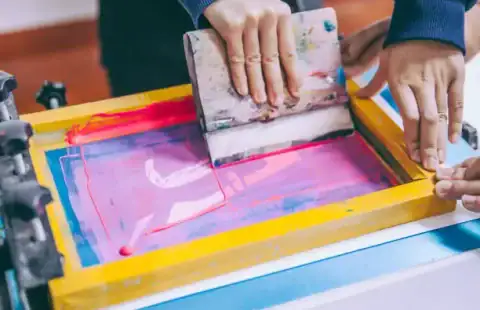
- Ragle system, It transfers ink to the surface by moving back and forth at an adjustable speed.
- The squeegee activates automatically and collects excess ink.
- The print head automatically lifts up when the printing is complete.
- The operator removes the product and replaces it with a new one.
The most important advantage here is, It means eliminating human error.
In manual machines:
- The pressure may vary.
- The squeegee angle may not be the same in every print.
- Quality may decrease as the operator gets tired.
- Achieving the exact same color tone can be difficult.
However In semi-automatic systems, the pressure force, speed, squeegee angles, and stroke length are all completely constant.. This ensures the same quality results across thousands of prints.
Semi-Automatic Screen Printing Machine
Which sectors use semi-automatic machines?
These machines are essential equipment, especially for medium and large-scale manufacturing businesses:
- Textile transfer printing manufacturers
- Plastic and plexiglass printing workshops
- Metal label manufacturers
- Glass printing companies
- Wood decorative printing workshops
- Manufacturers in the advertising and signage industry.
- In industrial product printing (measuring panels, logo prints, electronic components)
The main reason it can be used in so many different fields is that semi-automatic machines allow for precise control of printing force, angle, and speed.
Advantages of Semi-Automatic Screen Printing Machines
1. A significant increase in production speed.
It offers a speed advantage of 2 to 4 times compared to manual printing.
2. Consistent quality in every edition.
Thanks to the fixed squeegee angle, constant pressure force, and automatic system, every print looks the same.
3. Color consistency
Özellikle çok renkli serigrafi baskılarda büyük kritik olan renk tutarlılığı, otomatik cihazlarda neredeyse %100 sağlanır.
4. Lower labor costs
While an operator might print, for example, 300 products in a manual system, a semi-automatic machine can provide two to three times that amount of production output.
5. Long-lasting mechanical structure.
The machine components are manufactured to industrial grade, ensuring stable printing for many years.
6. Professional workshop view and job acceptance.
Most corporate clients want to see the workshop before delivering their work. These machines present a professional image that inspires confidence.
Semi-Automatic Screen Printing Machine
Semi-Automatic Machine or Manual Machine? Which is More Sensible?
Newly established workshops generally prefer entry-level manual machines. However, as customer potential and business volume increase, manual machines eventually become insufficient to keep up with the workload.
Disadvantages of the manual system:
- Printing speed is limited.
- Quality deteriorates as the operator gets tired.
- Printing in large formats can be very challenging.
- Color transitions and repeatability are poor.
Therefore, for businesses aiming for growth. semi-automatic screen printing machine, It is an almost inevitable investment.
Okan Gokhan Products
Machinery Products
- 👉 Semi-Automatic Screen Printing Machine
- 👉 Screen Printing Vacuum Manual Printing Machine – 70×200
- 👉 Screen Printing Desktop Printing Apparatus
- 👉 Semi-Automatic Circular Printing Machine
- 👉 Screen Printing Paint Drying Rack – Rayk
Related Informative Blog Posts
- 👉 What is a screen printing machine?
- 👉 Screen Printing Materials Guide
- 👉 Establishing a Screen Printing Workshop
- 👉 What is screen printing ink?
The Importance of Vacuum in Semi-Automatic Systems
Although many manufacturers overlook this, the vacuum system determines the fate of the print. Specifically:
- Plexiglass
- Metal
- Pine
- Wood
- PVC
- Thin materials in label form.
On surfaces prone to slipping, such as those mentioned, the absence of a vacuum will cause the print to be distorted, slip, or result in a double print problem.
The vacuum tables used in OkanGökhan machines provide much more stable printing thanks to industrial-grade channels, a powerful motor, and optimized air distribution.
The following product link can be highlighted here:
👉 Screen Printing Vacuum Motor (Spare Part)
What should be considered when choosing a semi-automatic screen printing machine?
Many businesses in Türkiye that want to increase their screen printing production capacity are taking the first step. semi-automatic screen printing machine People buy and take the plunge. However, choosing the right machine isn't as easy as it seems, as there are models with very different features on the market. Here, not only price but also factors like print quality, mechanical structure, vacuum power, electronic control units, service network, and spare parts access are of great importance. In this section, I will detail 10 critical criteria you must consider when choosing a machine. I will also illustrate each criterion with examples from OkanGökhan products to make your decision easier.
Semi-Automatic Screen Printing Machine
Semi-Automatic Screen Printing Machine
Semi-Automatic Screen Printing Machine
1. Printing Area and Frame Dimensions
When buying a semi-automatic machine, the first thing to look at is the printing area. If your production portfolio is limited to 30x40 cm, smaller models may suffice. However, if you produce textile transfer prints, wooden panels, glass surfaces, metal plates, and large plexiglass products, larger printing areas such as 50x70 cm should be preferred.
For example, one of the highly efficient models developed by Okan Gökhan is:
👉 Semi-Automatic Screen Printing Machine
With a 50x70 cm printing area, it is the ideal size for many large-scale industrial production applications.
Additionally, if you will be using large molds, the following frames are fully compatible with this machine:
The correct combination of plate structure, tension, and mesh selection is crucial because they directly affect print quality. For more detailed information on this topic:
👉 Screen Printing Mesh and Silk Selection Guide You can check out the link.
Semi-Automatic Screen Printing Machine
Semi-Automatic Screen Printing Machine
2. Vacuum Table and Vacuum Power
In a semi-automatic machine, one of the most critical components for stable printing is the vacuum system. If the vacuum table lacks sufficient traction, the workpiece will move, vibrate, slide, or double printing will occur. This is especially true if:
- Plexiglass
- PVC
- Metal
- Pine
- Thin cardboard
- On wooden surfaces
It creates a huge problem.
Therefore, when purchasing a machine, one should consider the power of the vacuum motor, the hole distribution of the table, the channel structure, and air optimization.
OkanGökhan systems use vacuum motors and tables that can easily secure even extra-wide surfaces. Furthermore, spare parts are very easy to obtain.
👉 Vacuum Cleaner Motor – Spare Parts
Vakumun stabil çalışması baskı netliği ve kenar keskinliği açısından %100 önemlidir.
Semi-Automatic Screen Printing Machine
Semi-Automatic Screen Printing Machine
Semi-Automatic Screen Printing Machine
3. Squeegee System: Quality of Forward-Backward Movement
The most important mechanical system that directly determines print quality on a machine is the squeegee movement.
The following features must be checked:
- Squeegee speed adjustment (digital control is an advantage)
- Ragle pressure adjustment
- Fixing the Ragle angle
- Automatic operation of the stripping squeegee.
- Engine torque
- Linear rail quality
Professional machines require consistent pressure as the squeegee moves, and there should be no vibration on the surface. If vibration occurs:
- Line prints deteriorate.
- The text appears blurry.
- Logo prints lose their clarity.
OkanGökhan's semi-automatic machines feature a squeegee carriage that operates with a high-strength linear bearing system. This allows for vibration-free printing even on heavy molds.
Also, for squeegee + scraper rubber needs:
👉 Screen Printing Squeegee
👉 Ragle Rubber
Spare parts such as these are readily available.
Semi-Automatic Screen Printing Machine
Semi-Automatic Screen Printing Machine
Semi-Automatic Screen Printing Machine
Semi-Automatic Screen Printing Machine
4. Z-Axis – Up/Down Movement of the Print Head
In a semi-automatic machine, the Z-axis controls the movement of the print head. This movement:
- Stable
- Silent
- Balanced
- At constant speed
- Smooth
It should be. If the Z-axis is shaky, paint distribution will be disrupted, especially on glass and metal surfaces.
Some inexpensive machines use weak motors for the Z-axis, causing the machine to struggle as the printing area increases. Therefore, you should ensure that the Z-axis structure of the machine you purchase is robust and industrial-grade.
5. Electronic Control Unit (System Brain)
The heart of the machine is the electronic control system. Each function requires precise management:
- Ragle speed
- Ragle rotation speed
- Stroke length
- Print head dwell time
- Number of prints
- Vacuum on/off timing
Being able to make these settings via the digital screen both enhances the user experience and ensures the repeatability of the print job.
OkanGökhan machines utilize industrial-grade control panels, ensuring durability against malfunctions.
Semi-Automatic Screen Printing Machine
Semi-Automatic Screen Printing Machine
Semi-Automatic Screen Printing Machine
Semi-Automatic Screen Printing Machine
6. Machine Body and Material Quality
The most important factor determining the lifespan of a machine is the quality of its housing. In a semi-automatic machine:
- Steel body
- Robust weld structure
- Anti-vibration aids
- Thick plate metal hardness
- Paint coating quality
This allows the machine to operate stably for 10-15 years.
Cheap machines are often found to use thin sheet metal, which over time causes the body to flex, the squeegee carriage to slip, and even hairline slippage during printing.
This is precisely why OkanGökhan machines use heavy and robust bodies.
7. Suitability for the Type of Paint to be Used
Not every type of paint is compatible with every machine. For example:
- UV paint
- Solvent-based screen printing paint
- Textile plastisol paint
- Water-based textile dyes
- Metal surface paints
Some squeegee pressure points need to be high, while others need to be low.
For paint applications, you can check out these products:
👉 Screen Printing Paint
👉 Screen Printing Retarder
For a detailed guide:
👉 What is screen printing ink?
8. Compatibility with Drying Systems
When you buy a semi-automatic machine, the first thing you need to think about is drying. Because if you're going to print at high speed, it's not possible to dry your prints manually.
Therefore, you should plan for compatible drying equipment. Examples:
In particular, fixing tunnels are essential equipment for all businesses that produce using plastisol paints.
9. Spare Parts Support and Technical Service
When choosing a machine, most people only look at price and features. However, in the long run, the most critical issue is... spare parts availability and service support. In Türkiye, finding parts for some imported machines can take months. This means halting production.
One of the advantages of the OkanGökhan brand is that all of its machines are manufactured in-house. Therefore, spare parts are:
- Ragle rubber
- Vacuum motor
- Roller
- Strap
- sliding parts
- Electronic control panel
All components, such as these, are supplied quickly.
10. Price/Performance Balance
The best machine isn't always the most expensive one. What matters here are your business needs. If you produce 500-1000 units per month, a semi-automatic system might be unnecessary for you. However:
- 300+ prints per day
- Textile transfer production
- Using 40x50 and 50x70 molds.
- Industrial surface printing
if you do jobs like these semi-automatic machine It is the most logical option in terms of price, speed, and quality.
Summary Checklist for Choosing the Right Machine
The following list should be reviewed before purchasing:
✔ Is the printing area suitable for your business?
✔ Is the vacuum power sufficient?
✔ Is the squeegee's back-and-forth movement stable?
✔ Is the Z-axis strong?
✔ Does it have a digital control unit?
✔ Is spare parts easily accessible?
✔ Is the service network widespread?
✔ Is the frame structure sturdy?
✔ Is it compatible with your paint types?
✔ Is it compatible with drying systems?
If you answer "yes" to all of these questions, you are choosing a semi-automatic machine that will work trouble-free for many years.
Strategies for Increasing Production Productivity with Semi-Automatic Screen Printing Machines
Purchasing a semi-automatic screen printing machine is a big step for your business, but unlocking its true potential requires proper production planning, the right combination of equipment, and the right workflow. In this section, I offer a detailed strategy guide for all workshops and businesses looking to achieve high productivity with semi-automatic machines. This guide contains crucial information for both beginners and professionals aiming for high production volumes.
1. Shape the production flow according to machine performance.
In semi-automatic systems, production speed depends on the speed at which the operator changes the workpiece. Since the machine already performs the printing automatically, the operator's preparation time becomes quite important. Therefore, you must adjust your production flow to the rhythm of the machine:
- The machine should not wait for the next operation while the operator removes one product and replaces it with a new one.
- The product placement point should be marked on the vacuum table.
- Multiple product preparation areas should be created; if at least two people are working, one of them should be constantly preparing the product.
Creating this kind of workflow minimizes production. %35 oranında hızlandırır.
If your products require faster drying, you must install a system compatible with this product:
👉 Conveyor Dryer – Fixing Tunnel
For large manufacturing companies, this tunnel is almost essential.
2. Professionalize Mold Making
One of the key factors determining efficiency in semi-automatic machines mold making. If the mold is poorly prepared:
- Does not retain color.
- The print won't come out clear.
- Ragle pressure force malfunctions.
- All the advantages of a semi-automatic machine are wasted.
Therefore, follow these strategies to prepare the mold:
• Select the correct mesh number.
Low mesh should be used for thick paint applications on metal, wood, or plastic surfaces, while high mesh is necessary for fine detail applications in textiles.
For more detailed information:
👉 Screen Printing Mesh – Silk Selection Guide
• Achieve professional exposure.
Poor exposure equals poor printing.
Exposure settings are crucial for capturing fine details, detailed text, QR codes, and logo prints.
For more information:
👉 Screen Printing Plate Exposure Settings
• The formwork frame must be sturdy.
High-tension frames have a longer lifespan in semi-automatic machines. Recommended products:
3. Adjust the paint density according to the machine.
Semi-automatic machines distribute paint much more evenly than manual systems. However, machine performance can decrease if the paint density is not adjusted correctly.
Plastisol paint for:
- It must be fluid.
- The scraping squeegee should work properly.
- The squeegee force should be increased for thick prints.
UV and solvent-based paints for:
- The speed must be high.
- The squeegee pressure should be low.
- A delay spray may be required.
Product links:
👉 Screen Printing Paint
👉 Screen Printing Retarder
The right paint mixture → for printing %100 renk tutarlılığı provides.
4. Optimize the Squeegee Angle for Each Job
In semi-automatic machines, the main factor determining print quality is the squeegee angle. Incorrect angle:
- It produces a shadowed print.
- Leaves excess paint
- It smooths out fine lines.
- It reduces clarity.
Because:
- For intricate detail work, the squeegee angle is steeper.,
- For jobs requiring high-density printing, the layout should be more horizontal.
Ragle accessories:
👉 Screen Printing Squeegee
👉 Ragle Rubber
Professional manufacturers use custom-made squeegee rubbers for each job. This improves quality.
5. Optimize Post-Production Drying
No matter how fast a printing press is, if your drying system is poor, production will be stifled. Products will start arriving one after another, and the workspace will become cramped.
Therefore, professional manufacturers use the following equipment together:
- For rapid production:
👉 Conveyor Dryer – Fixing Tunnel - For small workshops:
👉 Rayk Screen Printing Paint Drying Rack - For 50x70 cm jobs:
👉 Drying Rack 50×70
Workshops that optimize the drying process well are in production. %50’ye kadar hız artışı obtains.
6. Create a custom plan for transfer printing production.
Semi-automatic machines are particularly effective in transfer printing (plastisol transfer) production because:
- It maintains the same thickness with every print.
- The surface remains smooth before passing through the furnace.
- The color transitions are very clear.
- There is no blurring in multi-color printing.
Therefore, companies that produce transfer prints can print up to 3000 prints per day with a single machine.
7. Operatör Eğitimi ile Makine Verimini %40 Artırabilirsiniz
No matter how good the machine is, an untrained operator will seriously reduce productivity.
Because:
- Ragle speed adjustment
- Head landing/takeoff time
- Vacuum force control
- Mold change acceleration techniques
- Paint density adjustment
- Frame placement techniques
Operator training should definitely be provided on topics such as these.
between a trained operator and an untrained operator %40–%60 verim farkı It is formed.
8. Design Your Workspace Correctly
Workshop layout is just as important as machine selection. The following layout is standard in professional workshops:
- Preparation table
- Mold placement area
- Machine area (vacuum + semi-automatic system)
- Drying area (Ray rack or fixing tunnel)
- Final inspection/adjustment table
- Packaging area
This system significantly improves both workplace safety and production speed.
Those who want to set up a workshop can review this guide:
👉 Guide to Setting Up a Screen Printing Workshop
9. Periodic Maintenance Ensures a Longer Lifespan
Semi-automatic machines generally require minimal maintenance, but if regular maintenance is not performed:
- Ragle cart struggles
- The vacuum weakens.
- The engine starts making noise.
- The oil in the bearings dries out.
Therefore, maintenance should be performed every 3 months:
✔ Vacuum line cleaning
✔ Lubrication of Ragle Rails
✔ Z-axis control
✔ Tightening electrical connections
✔ Belt tension control
These maintenance procedures extend the life of the machine. It extends it by 2 times..
10. Measure and Improve Production Capacity
Most businesses that switch to semi-automatic machines notice an increase in printing speed, but they don't measure this speed. Knowing how much faster you've become is important for setting new capacity targets.
Sample measurement method:
- How many printouts were made in one hour?
- How many units were being purchased with the manual machine?
- Does it make a difference when the operator changes?
- At which stages does the most time loss occur?
By conducting these analyses, you can professionalize your production process.
1. Who is a semi-automatic screen printing machine suitable for?
Suitable for all medium and large-scale manufacturing businesses that require speed and quality standardization.
2. Is it difficult to switch from a manual machine to a semi-automatic machine?
No. The operator will fully adapt to using the machine within 1-2 days.
3. Which paints can be used in semi-automatic machines?
Plastisol, solvent-based, UV, water-based, and metal surface paints can be used.
4. What accessories should be purchased with the machine?
Squeegees, squeegee rubber, large molds, drying rack, and fixing tunnel are recommended.
5. How many years will these machines be used?
With regular maintenance, it can be used without problems for 10-15 years.
For those wishing to gain a deeper understanding of screen printing technology, reviewing some international resources may also be helpful:
- 👉 The History of Screenprinting Techniques – The Met Museum
- 👉 Screen Printing – Wikipedia
- 👉 What is Screen Printing? – Invisible
- 👉 How Does Screen Printing Work? – Printful