

Screen Printing Mesh Selection: Differences, Applications, and Impacts on Print Quality of 43T – 55T – 77T – 90T Meshes (2025 Guide)
Screen printing mesh selection

In screen printing, the mesh (silk) used is one of the most important components determining print quality. No matter how perfect the plate exposure time, film density, emulsion type, or machine settings are, choosing the wrong mesh directly impairs the print's clarity, detail level, and ink transfer. Mesh is known as the "hidden king" of the screen printing world because it is one of the most fundamental parameters determining the character of the print. Therefore, understanding the logic behind choosing the right mesh is critical for printers of all levels.
Screen printing meshes are generally T (thread per centimeter) In other words, it is expressed in terms of the number of threads per centimeter. Options like 43T, 55T, 61T, 77T, 90T, 120T are not sabotage techniques used in printing, but rather technical units that determine the character of the print. As the T value increases, the mesh is woven more tightly, open areas decrease, and it becomes possible to transfer finer details, but the amount of ink decreases. As the T value decreases, the mesh becomes more widely spaced, allowing for dense ink transfer, but the printing of fine details weakens.
Therefore, different mesh selections are required for textile printing, packaging printing, detailed drawings, halftone printing, or work where high coverage is desired. Mesh selection is a technical decision based on the printing purpose; using the wrong mesh can lead to ink bleeding, loss of detail, blistering, or insufficient coverage.
There are three key technical parameters in mesh selection:
- Number of Meshes (T)
- Thread diameter
- Open Area Percentage
These three parameters together determine the printing result.
The mesh count determines the level of detail to be used in printing, while thread thickness affects the thickness of the emulsion layer and the exposure time. The open area percentage determines how much ink can pass through. For example, let's consider two different 43T meshes: one with fine thread polyester and the other with coarse thread. Both are 43T, but because the open area percentage is different, one will allow more ink to pass through and the other less. Therefore, the printer must be familiar not only with the T value but also with the thread thickness.
Products by category

3x3 Frame 40x60 Metal Mold
Price range: 750.20 ₺ through 1,085.70 ₺ VAT Included3x3 Frame 50x70 Metal Mold
Price range: 826.10 ₺ through 1,267.20 ₺ VAT Included4x4 Frame 40x60 Aluminum Molding
Price range: 1,212.20 ₺ through 1,547.70 ₺ VAT Included4x4 Frame 50x70 Aluminum Molding
Price range: 1,420.10 ₺ through 1,861.20 ₺ VAT Included

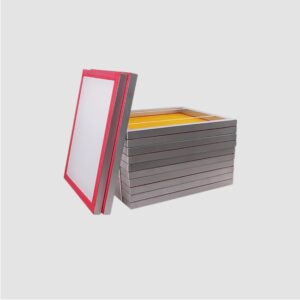
Screen printing mesh selection
Screen printing mesh selection
Screen printing mesh selection
The percentage of open area is of great importance, especially in textile screen printing. This is because pigment or plastisol dyes in textile printing are denser and more viscous than those used in other printing methods. Therefore, larger open areas facilitate dye transfer and allow for a fuller print in a single pass. This is why 43T is the standard mesh for textile printing. It is ideal for coverage in both flat and block printing.
Now let's examine some of the most commonly used meshes individually.
⭐ 43T Mesh – The Standard for Textile Printing
43T mesh is the most commonly used mesh type in the screen printing industry, especially in textile printing. This is because of its large open area percentage, its ability to easily pass ink through, and its coverage in a single application. It is compatible with plastisol, PVC, and water-based textile inks. 43T mesh is preferred in t-shirt printing for white backgrounds, full text printing, logos, large areas, and all applications requiring high coverage.
Advantages of 43T mesh:
- Provides high coverage.
- It transfers the paint intensely in a single pass.
- It gives clear results in large graphs.
- Mold exposure is easy.
- The exposure time is short.
- Equipment adjustment tolerance is wide.
The disadvantage of the 43T is that it is inadequate for very fine details. Details can be lost in small text, halftones, or delicate line art.
⭐ 55T Mesh – The Golden Mean Between Detail and Coverage
55T mesh is more tightly woven than 43T but still allows sufficient ink to pass through. It's an ideal balance, especially for jobs requiring both detail and opacity. It's very suitable for monochrome logos, medium-detail graphics, and both textile and flat surface prints.
Advantages of the 55T:
- It provides better detail than the 43T.
- It allows more paint to pass through compared to 77T.
- It is compatible with both plastisol and water-based paints.
- More stable printing is achieved.
Especially in water-based printing, 55T mesh is highly preferred for both control and coverage.
Screen printing mesh selection
⭐ 77T Mesh – Ideal for Fine Detail, Line Art, and Halftones
77T mesh is a professional choice preferred for detailed work. Because it has a lower percentage of open areas, ink transfer is minimal, but it produces fine lines, tiny text, and halftone dots very successfully. It is used for packaging printing, art printing, and highly detailed textile work.
Areas of application for the 77T:
- Halftone (raster) prints
- Finely detailed drawings
- Small print
- Smooth transition graphics
- Fine contours
When working with 77T mesh, the exposure time is longer than with 43T and 55T. This is because the mesh is more tightly woven and requires a thinner emulsion surface.
⭐ 90T Mesh – For Very Fine Detail and Industrial Printing
90T mesh is preferred for jobs requiring ultra-fine detail, high resolution, and minimal ink flow. It is used in delicate applications such as industrial components, electronic circuit prints, fine line logos, and photo prints.
90T mesh specifications:
- Paint penetration is minimal.
- The level of detail is highest.
- Requires professional exposure.
- Halftone dots are very clearly visible.
It is generally ideal for water-based fine printing and industrial applications.
Mesh Tension, EOM (Emulsion Thickness), Mesh Selection According to Paint Type, Factors Affecting Detail Loss, and Professional Mesh Settings (900+ words)
The quality of screen printing depends not only on the mesh count but also on the mesh tension, EOM (Emulsion Over Mesh) value, the type of emulsion used, the ink viscosity, and the compatibility of the equipment. Although printing operators often attribute problems to the ink or plate, the fundamental issue largely lies in the mesh tension and stencil structure. In this section, we will discuss the mesh-tension-emulsion relationship, which determines professional print quality, in detail.
Screen printing mesh selection
⭐ What is Mesh Tension and Why is it Critical?
Mesh tension refers to how tightly the silk is stretched over the aluminum frame. Tension is measured in Newtons (N/cm). In professional textile workshops, mesh tension is usually... 20–30 N/cm It should be within this range. At lower tension, the mesh bends during printing, springs under the squeegee, and details are distorted. Higher tension means less ink transfer, sharper details, and more stable printing.
Problems observed in low-tension meshes:
- Loss of fine details
- Uncontrolled spread of paint
- Halftone dot structure distortion
- The background details are not sharp in the exposure.
- Shadowing during squeegee transitions
- Rough edges in monochrome printing.
Düşük gerginlikli bir mesh, en iyi serigrafi makinesinde bile kötü sonuç verir. Rakle baskı yaptığında mesh “yatak” gibi çöker ve boyayı olduğundan fazla bırakır. Bu yüzden gerginlik, baskı kalitesinin %50’den fazlasını oluşturur.
Professional ideal tension values:
- 43T: 20–26 N/cm
- 55T: 22–28 N/cm
- 77T: 24–30 N/cm
- 90T: 26–32 N/cm
Low mesh tension leads to irreparable quality loss, especially in halftone prints.
Screen printing mesh selection
Screen printing mesh selection
⭐ EOM (Emulsion Over Mesh) – The Effect of Emulsion Thickness on Printing
EOM (Emission Value) is the thickness of the emulsion layer on the mesh. The thicker the emulsion, the deeper the open areas become and the more color passes through. If the EOM is too thin, the print coverage decreases; if it is too thick, details are distorted and the exposure time increases.
Professional EOM values generally include:
- Tekstil plastisol baskı: %20–35
- Su bazlı baskı: %10–20
- Halftone printing: %5–10
- Industrial fine prints: %3–6
The EOM (Energy Odor) value is key to achieving quality results, especially in large, opaque prints. For example, a single coat of emulsion is insufficient for 43T mesh; a 2+1 (2 on the inside, 1 on the outside) or 1+1 coating is more appropriate for plastisol.
The disadvantages of very high EOM:
- Long exposure times
- Covering up the fine details
- Bubble formation under emulsion
- Extension of the institution's term
The disadvantages of very low EOM:
- Insufficient coverage.
- The dye appears sparse on the fabric.
- Halftone point attenuation
- The edges of the pattern should not be sharp.
The balance of stencil thickness should be determined by the mesh count, ink type, and printing surface.
⭐ Mesh Selection Based on Water-Based & Plastisol Paints
Screen printing mesh selection
Screen printing mesh selection
Mesh selection depends on the type of paint used, as paint viscosity and drying method directly affect its behavior on the mesh.
Mesh Selection for Plastisol Paints
Plastisol paint is thick and dense, making it ideal for meshes with large open areas:
- 43T → Block prints, dense closure.
- 55T → Medium detail + coverage
- 61T → More controlled transition in color separation processes.
- 77T → Halftone plastisol applications
Plastisol mesh is a more tolerant choice because plastisol does not deteriorate, does not dry quickly, and is stable during squeegee passes.
Mesh Selection for Water-Based Paints
Because water-based paint is more fluid than plastisol, a higher mesh size is used:
- 55T → General standard for water-based printing
- 61T → Detailed chart and medium coverage
- 77T → Finely detailed water-based works
- 90T → Water-based halftone and fine lines
Furthermore, mesh tension is of greater importance in water-based paint; water-based paint may bleed through low-tension meshes.
Screen printing mesh selection
Screen printing mesh selection
⭐ Mesh Factors Affecting Detail Loss
The most important factor in understanding why fine details are lost in a print is the mesh structure. Incorrect mesh selection or insufficient tension can lead to the following problems:
1) Low Open Area
If the mesh is too tightly woven (above 77T), details cannot transfer from the film to the mold.
2) Incorrect Mesh-Emulsion Ratio
If EOM is too high, fine details are drowned out in the emulsion.
3) Low Mesh Tension
Low tension = silk twisted on the squeegee → loss of detail.
4) Incorrect Film Density
If the film's black is not opaque, details will not be revealed during exposure.
5) Incorrect application of emulsion
Unevenly coated emulsions cause fine details to be lost.
6) Wrong DPI
If the film is printed at a low resolution like 300 DPI, detail will be lost regardless of the mesh size.
Because For detailed work, the mesh, film, and emulsion trio must be optimized together.
⭐ Professional Printers' Mesh Preference Chart
The following table summarizes the mesh habits of actual repressors worldwide:
| Printing Type | Optimal Mesh |
|---|---|
| Textile flat printing | 43T |
| Single color logo | 43T – 55T |
| Water-based printing | 55T – 61T |
| Detailed line art | 77T |
| Halftone plastisol | 77T |
| Halftone water-based | 77T – 90T |
| Industrial fine printing | 90T – 120T |
Adding this table to your blog will be very helpful and will also increase your chances of getting a featured snippet on Google.
The Relationship Between Mesh and Exposure, Mesh Selection for Halftone Details, Mesh Choice Based on Print Surface, Mesh Lifespan – Maintenance and Professional Mesh Management (900+ words)
Screen printing mesh selection plays a critical role not only during printing but also during the exposure phase. The more tightly woven the mesh, the more difficult it is for UV light to penetrate the emulsion; therefore, the exposure time increases. Similarly, a mesh with a wide open area allows UV light to pass through much more easily, shortening the exposure time. In other words, the accuracy of the exposure directly depends on the mesh structure. Mesh selection should be made according to the type of print, film opacity, emulsion type, and light source.
The basic logic of the mesh-exposure relationship is as follows:
As the silk weave becomes denser, UV transmission becomes more difficult → exposure time increases → details become more delicate → error tolerance decreases.
Therefore, exposure times at higher mesh sizes like 90T can be 2–3 times longer than at 43T.
The accuracy of the exposure also depends on the thickness (EOM) of the emulsion applied to the mesh. If the emulsion is too thick, the exposure time will be longer; if it is too thin, the exposure will be faster, but the coverage may be poor. The denser the mesh, the thinner the emulsion layer should be. For example, applying a thick 2+2 emulsion to a 90T mesh can lead to the loss of fine details. Therefore, professional printers prefer thin and delicate emulsion coatings on 90T and higher meshes.
Mesh selection also affects the post-exposure developing stage. The developing process is more delicate with tightly woven meshes because water penetration is more difficult. Fine raster points or small details can be damaged by high pressure. Therefore, with high-exposure meshes, developing should be done at low pressure and in a controlled manner.
Mesh selection is particularly important for halftone (raster) prints. For accurate raster dots, the mesh must be both tightly woven and high-tension. 43T or 55T meshes may be insufficient for accurately displaying raster dots due to their wide open area. 77T and 90T meshes, on the other hand, have the ideal weave density for halftone printing.
In raster printing, mesh selection is done as follows:
- 35–45 LPI halftone → 61T – 77T
- 45–65 LPI halftone → 77T – 90T
- 70–85 LPI halftone → 90T – 120T
In raster printing, the goal is to transfer the dot structure to the plate without distortion. Inadequate mesh selection leads to dot gain problems. Dot gain occurs when fine dots expand during exposure, distorting tonal transitions in the print. Therefore, film opacity and exposure time must be adjusted much more precisely with 77T and higher mesh sizes.
Mesh selection also varies depending on the printing surface. Wider open-area meshes are preferred for textile printing, while denser meshes are used for paper and flat surface printing. This is because paper requires a much thinner ink layer and a higher level of detail.
Mesh selection according to the printing surface:
Textile Printing
Conditions vary, surface textured → wider mesh
- 43T → Coverage and ground
- 55T → Detail + coverage
- 61T → Water-based medium detail
- 77T → Raster Textile
Paper Printing
The paint needs to be applied very thinly → tight mesh.
- 77T → General chart
- 90T → Logo and fine details
- 120T → Fine drawings
Plastic and PVC Printing
High sharpness on the film surface → medium mesh density
- 61T – 77T – 90T
Ceramic, Metal, Glass Prints
Paint is applied very thinly → high mesh
- 90T – 120T – 140T
Industrial Electronic Prints
Pad, solder mask, circuit board → ultra-dense mesh
- 120T – 150T – 200T
Mesh lifespan also affects print quality. Mesh loosens over time after being stretched; this loosening occurs more rapidly, especially with low T-value films like 43T and 55T. Professional studios replace meshes every 6–12 months. When mesh tension decreases, the mesh bends under squeegee pressure, and details are distorted. Therefore, mesh tension should be measured regularly with a tensiometer. When the mesh tension falls below 18–20 Newtons, it is no longer suitable for professional printing.
Mesh replacement period:
- Workshops that produce high-volume print jobs daily: Every 3–6 months
- Medium-level production: 6–12 months
- Hobby workshops with low production volumes: 12–24 months
Mesh maintenance is also crucial for maintaining quality. If paint residue remains on the mesh surface after the mold is removed, it will settle between the fibers and affect paint transfer in subsequent prints. Therefore, mesh cleaning should be done with professional ink remover and degreaser products. Bleach, thinner, or harsh chemicals weaken the mesh fibers and shorten their lifespan.
The type of business the workshop conducts and the customer profile should also be considered when choosing a mesh. For example:
- Small boutique textile printers → 43T – 55T
- Workshops that do detailed graphic design work → 55T – 77T
- Advertising agencies → 61T – 77T – 90T
- Industrial applications → 90T – 120T
Mesh optimization is a crucial factor determining production speed and quality in a workshop. Choosing the wrong mesh makes printing more difficult, leads to customer complaints, and increases costs.
Screen printing mesh selection
Screen printing mesh selection
Screen printing mesh selection
Screen printing mesh selection
FAQ – Frequently Asked Questions (Screen Printing Mesh Selection)
What is mesh in screen printing?
Mesh is a polyester fabric that forms the screen printing plate and allows the ink to pass through. It is expressed with values such as 43T, 55T, 77T, 90T, etc., and determines the print quality.
Which mesh type should be used for which task?
- 43T → Coverage in textile printing
- 55T → Detail + coverage
- 77T → Fine details, halftone
- 90T → Very fine lines and industrial printing.
What should the mesh tension be?
Professional tension generally 20–30 N/cm It's in between. If the tension is low, details get distorted, and the pressure overflows.
Which mesh is preferred for water-based printing?
55T, 61T, and 77T mesh sizes provide the most stable results for water-based printing.
Which mesh is best suited for halftone printing?
Generally 77T and 90T The meshes have the ideal weaving density for halftone.
What is the lifespan of mesh?
They last 3–6 months in workshops with high daily production, 6–12 months in medium-intensity workshops, and 12–24 months at hobby level.
Does mesh selection affect exposure time?
Yes, exposure time increases as mesh density increases. 90T meshes take 2–3 times longer to expose than 43T meshes.
If you would like to learn the basic structure of screen printing What is screen printing? You can take a look at our article.
To learn more about the exposure phase in detail. Screen Printing Plate Exposure Settings This guide is perfect for you.
For technical information on film density and DPI, see [link to relevant documentation]. Screen Printing Film Output The details are in the article.
Most printing errors result from mesh-plate mismatch; Screen Printing Errors This will help.
To understand the effects of water-based and plastisol paints on mesh. What is screen printing ink? You can also take a look at the article.
Choosing the right equipment for post-printing drying. Rayk Screen Printing Paint Drying Rack
For more detailed technical information Screen Printing – Wikipedia You can check the source.
For screen printing trends worldwide. FESPA The official website offers a wide range of content.
Reference documents for the printing industry. Printing.org It is a successful resource.
Screen printing mesh selection
Screen printing mesh selection
Screen printing mesh selection
Screen printing mesh selection
Screen printing mesh selection
Screen printing mesh selection
Screen printing mesh selection
Screen printing mesh selection
Screen printing mesh selection

